

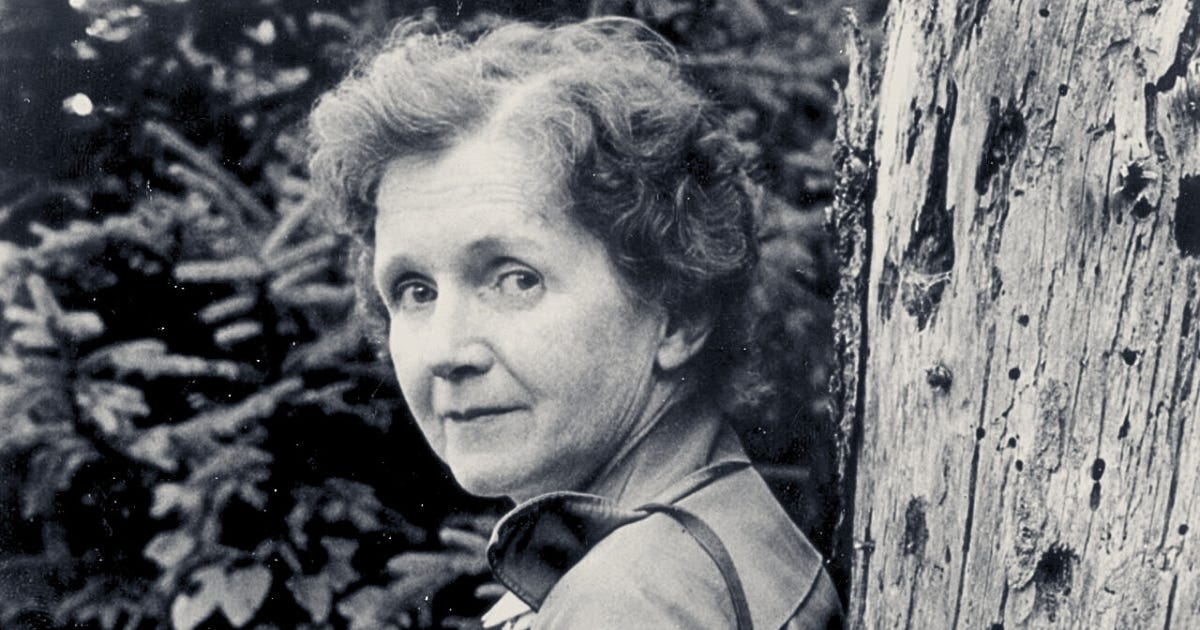
Thomas Brosnihan, CC BY-SA 4.0 via Wikimedia Commons
She chose to make this last farewell at low tide. Their “fairy cave” would have emerged, the tidepools within waiting to be explored.
Poor Rachel, Dorothy thought. She had so wanted to comb this beach one last time.
She choked back a sob and hefted the plain cardboard box. Rachel’s brother had carelessly mailed it to her here in Maine. No note. Stepping carefully over the mossy rocks at the fairy cave’s opening, she dipped her hand into the ashes.
One last caress. Gritty and chalky.
Rachel Carson grew up on a farm in western Pennsylvania, but was drawn to the sea. The farm provided little income, but her mother made it a fertile laboratory for a curious girl. She sent her children out on the 64 acres to examine God’s creation and discover man’s “divine obligation” to conserve it.
Perhaps the seashell fossil young Rachel dug from a riverbank sparked the first question that would lead her to the ocean and its mysteries. But writing is what truly floated her boat. She was 10 when she published her first article in the St. Nicholas children’s magazine (joining F. Scott Fitzgerald and E.B. White among the magazine’s writing contest winners). She was 14 when she received her first check from the magazine. And she would pitch stories to newspapers, magazines, and book publishers ever after.
She had to hustle. Due to death and desertion, she became the primary provider for her mother and two nieces just as she graduated from Johns Hopkins University with a master’s degree in zoology. It was 1932, the depths of the Great Depression.
She got a day job at the U.S. Bureau of Fisheries and earned $20 here and there selling articles to the Baltimore Sun. Fisheries’ news releases, government reports, brochures, and guides never read more clearly or sang more beautifully.
Her boss said one piece was too good for a fisheries brochure. “Send this one to the Atlantic,” he said. When the Atlantic Monthly published her essay “Undersea” in September 1937, the world was introduced to a whole new universe under the waves and to a writer of remarkable talent.
In the article, Carson pulled readers off the beach, through the shallow reefs, and out to the continental shelf and the yawning abyss. Along the way, she described peculiar creatures eating, living, and dying in bizarre ways. Scientific details were served up in delightfully digestible bites.
Readers in their armchairs had “seen” nothing like it. Jacques Cousteau had not yet invented the Aqua-Lung nor begun making underwater documentaries. Carson opened new territory to the popular imagination and awakened her readers to the interdependence of man and nature.
“Thus we see the parts of the plan fall into place: the water receiving from earth and air the simple materials, storing them up until the gathering energy of the spring sun wakens the sleeping plants to a burst of dynamic activity,” she wrote. “Against this cosmic background the life span of a particular plant or animal appears, not as a drama complete in itself, but only as a brief interlude in a panorama of endless change.”
A scientist with a poet’s pen. A woman breaking barriers. She would move the world.
Dorothy Freeman remembered Rachel’s delight upon discovering their fairy cave, its opening obscured by a curtain of roots and fern. Within, sea stars clung to rocks. Hermit crabs skittered between pools. A seafoam-green anemone’s tentacles waved in a gentle current from the cave’s dripping ceiling.
Rachel had her bucket and carefully lifted specimens for closer inspection back at her cottage. She returned them to the sea, of course. Dorothy chuckled at the memory of Rachel rescuing a lightning bug that kept diving into breaking waves, mistaking bioluminescence for a swarm of compatriots.
Dorothy turned from the cave and stepped carefully across slick, weathered rocks toward the lapping waves. The first handful of ashes scattered across Rachel’s precious tidepools; some appeared to melt into the rock as they soaked up seawater; others lingered a bit on the tidepool’s surface, before settling into the salt-and-pepper pebbles of the pool’s floor.
This is what Rachel wanted and what her brother tried to prevent. He had relented, burying half her ashes with their mother and sending the other half to her in the mail. Perhaps he was jealous of their relationship. Or perhaps he felt he knew better what was good for his sister.
Men.
The Atlantic Monthly article appeared under the byline “R. L. Carson,” at Carson’s insistence. As one of only two women scientists in the Bureau of Fisheries, she found that her reports were given more weight if the writer was presumed to be male. Her instinct would be confirmed over and over again, even when her books topped bestseller lists.
The “Undersea” article led to a trilogy of books about the ecosystems of the shore, the sea, and its depths. The Sea Around Us was a breakout hit, and reviewers routinely marveled that such a deep and serious book had been written by a “petite and pretty” woman. One who was unmarried, no less.
“She sometimes envied male writers who married because they had wives to take care of them, provide meals, and spare them from unnecessary interruptions,” her biographer, Linda Lear, wrote. Perhaps she never married precisely because no husband could see himself in that role.
Her books about the sea raised issues that were uncomfortable in an era when men blasted Pacific atolls to test the power of atomic bombs, when “progress” was marching faster and faster, heedless of consequences.
But her books also gave her a platform. At awards banquets and society luncheons, she spoke up for nature, becoming more and more vocal about man’s negative influences on it. In the ‘40s and ‘50s, it was a time of fearsome revelations: Of radioactive fallout, of harmful food additives, and of medications that caused hideous birth defects.
“The beauty of the living world I was trying to save has always been uppermost in my mind—that, and anger at the senseless, brutish things that were being done,” she wrote to a friend.
An avid birdwatcher, Carson became alarmed by reports of disappearing bird species in the South, where post-war America was waging “war” on fire ants. DDT, developed during World War II to fight lice and insect-borne diseases among the troops, was declared a “miracle” chemical. The Department of Agriculture was mixing the stuff in oil and dumping it on entire neighborhoods from airplanes and roadside sprayers. The extermination of the “relentless rival of man” was hyped in a USDA video titled Fire Ant On Trial.
Carson, the scientist, dove into the research and interviewed chemists and physicians. Carson, the former government interpreter, worked her sources in the Department of Agriculture. Carson, the emerging celebrity, enlisted the powerful, including Interior Secretary Stewart Udall.
The result was her magnum opus, Silent Spring, published in 1962. It opens:
There was a strange stillness. The birds, for example—where had they gone? Many people spoke of them, puzzled and disturbed. The feeding stations in the backyards were deserted. The few birds seen anywhere were moribund; they trembled violently and could not fly. It was a spring without voices.
Indiscriminate spraying stilled the birds, poisoned the water, and probably caused cancer, Carson wrote. She connected dots as no one had before. She uncovered the seamy side of unchecked progress.
The intensity of the chemical industry’s criticism betrayed its vulnerability. A lawyer for the Velsicol Chemical Company threatened the publishers with a lawsuit. Carson, he wrote, might be part of “sinister forces” trying to “create the false impression that all business is grasping and immoral.” Former Agriculture Secretary Ezra Taft Benson wondered, “Why a spinster with no children was so concerned about genetics.” His conclusion: “probably a communist.”
Scientists on the payroll of DuPont, Monsanto, and the National Agricultural Chemicals Association belittled her master’s degree in zoology. They went on television to explain that modern food production was too important and complex to be addressed in a mass-market book. Public relations teams put together mass mailings, including a brochure for county agricultural extension agents titled “How To Answer Rachel Carson.”
But Silent Spring landed on a public that was becoming wary of “the notion that chemists are the possessors of divine wisdom,” as a New York Times editorial put it. There were congressional hearings and studies. Congress amended the law to prohibit use of insecticides before their safety had been tested.
But by then, Rachel Carson was dead.
Dorothy Freeman was one of the very few who knew that Rachel wrote Silent Spring in a race against cancer. In the 10 years she had known her, cancer had spread from her breast to her neck, to her bones, and to her liver. Massive doses of radiation weakened her. She went blind for a while. Her writing hand went numb.
But she kept her condition secret, even as she endured radio interviews, Congressional testimony, and banquet speeches. She feared her detractors would twist her illness into some kind of ulterior motive.
She had so much more to say. But her heart gave out on April 14, 1964, just eighteen months after Silent Spring was published.
Dorothy knew why it was so important to Rachel that her ashes be spread here at Sheepscot Bay, where they had spent summers together. Rachel had given her life, and now she would give her body to nature. As she had written in that Atlantic article long ago: “There descends into the depths a gentle, never-ending rain of the disintegrating particles of what once were living creatures of the sunlit surface.”
She no longer walked the sunlit surface, but Carson’s words lived on. The public was awakened to the link between “progress” and the brown clouds over cities, the polluted rivers catching fire, and the seabirds dying in oil slicks. The Ecology Movement was born. The first Earth Day was held in 1970, ushering in what became known as the “environmental decade.”
Carson’s friends in Congress, pushed by the growing environmental movement, strengthened restrictions on pesticides, passed the Clean Water Act, the Clean Air Act, and the Endangered Species Act. Presidents Nixon, Ford, and Carter signed them into law.
In signing the bill that created the Environmental Protection Agency, Nixon proclaimed: “Each of us all across this great land has a stake in maintaining and improving environmental quality, clean air, and clean water. These are part of the birthright of every American.”
But an economic downturn came—as they do—and industry saw its chance. Rising gas prices, high interest rates, stagnant wages: These were the result of government regulation. A former actor gave them the perfect line: “The nine most terrifying words in the English language are, ‘I’m from the government, and I’m here to help.’”
Ronald Reagan was elected president in 1980 and the country took a hard wrong turn.
The Superfund toxic waste cleanup program was the last environmental measure to pass before Reagan came to town. The measure required petroleum, chemical, and manufacturing companies to pay into a fund to clean up thousands of dumps that industries had used and abandoned over the previous decades.
Chemicals from the worst such dump in California, the Stringfellow Acid Pit, were oozing into waterways in the town of Glen Avon. Kids made toxic beards out of the frothy storm runoff. Then they started seeing double. The eager young scientists who hired on to the new Superfund program to solve such problems ran into an obstacle: Their new leader, Rita Lavelle, appointed to the job by Reagan. Lavelle, a former spokeswoman for Aerojet, one of the Stringfellow Pit’s toxic dumpers, thought it unfair that companies be held accountable for messes made by companies long ago. She made some calls to her old colleagues at Aerojet.
Lavelle’s boss was Reagan’s EPA Director Anne Gorsuch, a former Colorado state legislator who belonged to a group that called themselves the “House Crazies.” She supposedly walked into a petroleum industry luncheon once, lit up a Marlboro, and said, “I’m from EPA, and I’m here to help.”
She had a like-minded partner on the Cabinet, Interior Secretary James Watt. He opened the country’s coastal waters to oil drilling, eased restrictions on strip-mining, and opened federal lands to the coal companies.
It’s a testament to the ecology movement’s enduring power that Gorsuch’s collusion with industry and gutting of EPA staff got her into hot water with Congress. Similarly, Lavelle’s mishandling of Superfund landed her in jail for perjury before Congress.
Reagan cut them loose, but kept Watt. Until Watt described the diversity on his coal leasing review panel: “I have a Black. I have a woman, two Jews, and a cripple.” Such language was politically fatal back then.
The Reagan Revolution changed government. Reagan had required all federal regulations to go through a “cost-benefit analysis.” That meant running everything by David Stockman, his budget director, who didn’t see much benefit in anything the government did. The scales have been tilted in industry’s favor ever since.
Reagan’s environmental legacy was entrenched in the courts. His judicial nominees were screened for their fealty to free enterprise. John Roberts, a young lawyer on the White House staff, would go on to be Chief Justice of the Supreme Court. And in that role, he would author West Virginia v. EPA, a ruling that undercuts the EPA’s ability to fight climate change. Concurring in that ruling was Justice Neil Gorsuch, Anne’s son.
Dorothy Freeman, empty box in her hand, watched the waves carry her friend’s ashes out to sea. Chemistry and the divine had conspired to create life in those waters, Rachel had said. And it would forever do so, despite the “senseless, brutish things” man has done.
The question is, will we be there to enjoy it?
Sources
I read Carson’s Silent Spring just recently. It still resonates. The enemies of nature are the same, still short-sighted, still making the same justifications.
“Undersea,” her first article in the Atlantic Monthly, is truly beautiful. The Atlantic’s digital archive serves it up with the byline “Rachel Carson.” But a PDF of the original print version verifies it was published under the byline “R.L. Carson.” You can see it here.
Linda Lear’s Rachel Carson: Witness For Nature helped me grasp the roots of Carson’s passion, the obstacles she had to overcome, and the full depth of her influence on mid-century society and politics. As a writer, I found the publishing back stories fascinating.
I am old enough to see history repeating. As a newspaper reporter, I covered the “House Crazies” in the Colorado Legislature, and got out the popcorn when Anne Gorsuch was named to head the EPA. I refreshed my memory about the Reagan Administration’s DOGE-ing of the EPA by listening to a series on the topic broadcast in 2022 by the excellent NPR/WBUR program “Here & Now.” The series can be found here.

This was beautifully written. You didn't just tell her story—you brought her to life. I can really feel her passion and courage. By the end, I was really inspired.