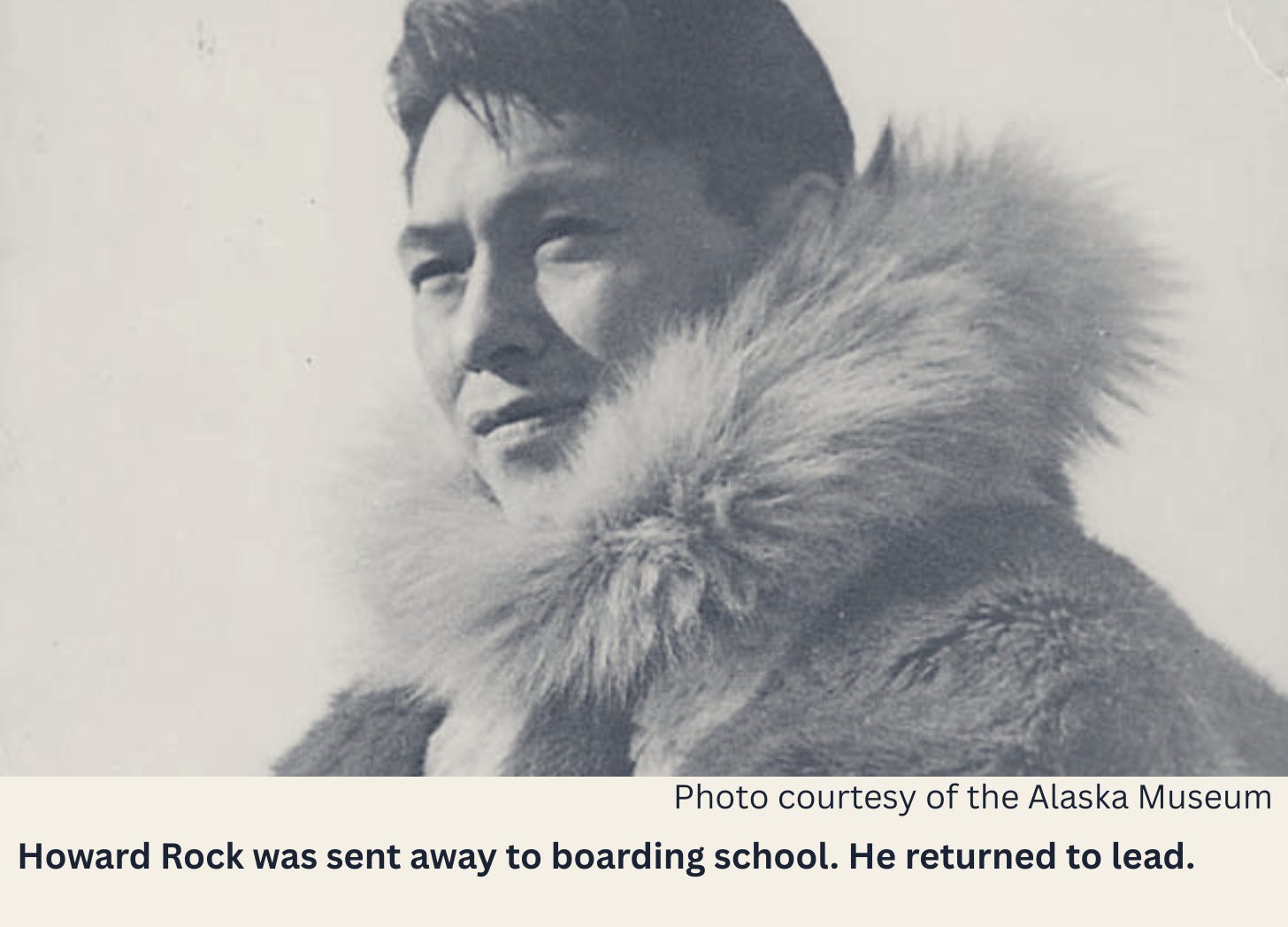
Hundreds of caribou bounded across the marshy valley bottom, perhaps spooked by a wolf pack. The treeless tundra was a mottled green canvas splashed with dabs of vivid purples and blues. Spring flowers had awakened, and the migrating herd stopped their stampede to graze on the new growth along the glacial waters of the Ogotoruk. The hunters had no difficulty bagging several.
For centuries, Howard Rock’s Inupiat people came here after the long winter, hankering for something other than whale meat. He looked forward to tonight’s feast, though he carried not a rifle, but a sketchbook.
He had not walked the tundra in decades. Not since being sent away to boarding school, an extra mouth to feed. The bookish boy went on to travel the world with the Army, go to college, marry and divorce a white woman, and make a living carving ivory for the Seattle tourist trade. Life in the Lower 48 filled his bank account, but drained his soul. He had returned to Point Hope to regain his muse, but the village still didn’t know what to make of him.
“Maybe so much of your brain was devoted to painting there wasn’t room for the usual Eskimo instincts,” his brother, Allen, had said while admiring a dynamic whale hunt scene Howard had painted. He invited Howard on the hunt.
Where Ogotoruk Creek flowed into the Arctic Ocean, the hunting party passed by rows of military huts awaiting the summer crew from the Atomic Energy Commission. The villagers had heard disturbing rumors about what was going on there.
--
In 1852, the U.S. Senate secretly rejected 18 treaties with 134 Indigenous California tribes. It hid the terms of the agreements, giving free rein to land grabbers. It was more than 100 years before the Pit River Nation proved that 3.5 million acres had been stolen. The government offered 47 cents an acre; the Pit Rivers said no thanks. It wasn’t about the money.
The Inupiat people did not need to mark their territory. They ranged as far as they needed. But Rock’s father put in a claim with the U.S. government for the Ogotoruk Valley when miners and real estate men started staking claims in the ‘50s. He thought it better safe than sorry.
But the Bureau of Land Management did not recognize hunting and fishing as proof of occupancy. Farms hadn’t been staked out. Nothing had been built there. So it considered the valley available when H-bomb inventor Edward Teller went looking for a place to detonate a nuclear bomb.
Teller wanted badly to prove peaceful uses for his bombs. Blasting out a deep-water port was one idea. No one wanted or needed one in Northwest Alaska, but it had “the fewest people and the most reasonable people,” Teller told the media in Juneau in 1959. He neglected to clue in the “reasonable people” in Point Hope.
Now, two years later, an Atomic Energy Commission team was digging holes and taking readings at the mouth of the Ogotoruk. The village learned the truth from a skeptical sociologist from the University of Alaska: Teller’s Project Chariot would bury a bomb just 30 miles from their village. It would be 14 times more powerful than the one dropped on Hiroshima. Radiation warnings were ignored. State government was lulled by promises of money and jobs.
Now Point Hope discovered Rock’s worth. Families had sent their kids to boarding school out of desperation, but they returned wise to the ways of whites. Rock wrote a letter opposing Project Chariot to the U.S. Secretary of the Interior. When an emissary was sent to Barrow, he found village chiefs who had savvy, English-speaking advisers.
The fledgling confederation of tribes helped kill Project Chariot. Power in unity was awakened. The Alaska Federation of Natives was formed, and Rock was tasked with starting a newspaper to be its herald.
By October 1962, Rock reluctantly stowed his paintbrushes and moved to Fairbanks to start a biweekly newspaper. Mail planes dropped the Tundra Times in remote villages, where boarding school graduates translated for their parents. Alaska Natives coalesced around common problems and developed joint solutions.
Just in time to meet the greatest threat to their way of life: The discovery in 1968 of oil on Alaska’s North Slope.
--
Congress in 1877 reneged on a treaty signed only nine years earlier and took the Black Hills from the Lakota (Sioux) Nation. More than 100 years later, the U.S. Supreme Court ruled the maneuver the most “ripe and rank case of dishonorable dealing” in American history. The government offered $106 million; the Lakota rejected it. It wasn’t about the money.
The first Congress of the United States promised that Indigenous lands “shall never be taken from them without their consent.” In 1884, Congress said whatever claims Natives had on land in Alaska would not be “disturbed,” but left final settlement of claims to a future Congress. Final determination of the Natives’ land claims was punted again when Congress accepted Alaska as the 49th state in 1958.
The question could no longer be avoided when ARCO and Humble Oil proposed drilling in the far north in the midst of a national “energy shortage.” Oilmen were tossing money around. The state was itching to claim resource-rich land. Secretary of the Interior Stewart Udall chose the Tundra Times’ annual fundraising banquet in 1968 to announce a freeze on any further land claims until Congress settled Native rights.
It all came to a head in the Congressional session of 1971. Rock wrote in a New Year’s editorial titled “Air of Expectancy” that Natives “above all else, want a good settlement knowing they are about to give up forever great expanses of land they have lived on through the ages in the past. There is no rejoicing in the impending event.”
The Alaska Federation of Natives entered the stuffy Washington hearing rooms speaking the language of legacy and place: thousands of years in harmony with boundless nature. They were forced to speak the language of capitalism: boundary lines and dollar signs.
It was only about the money. The Alaska Natives were forced to take the wrong turn.
Native negotiators were not excited about the deal, but said it was the best they could get. AFN President Don Wright sounded like a CEO as he tried to justify it to his people: “Each individual will be a stockholder in a corporation on the village level.”
Some in Congress thought the Natives made out like bandits. But at least the nagging issue had been settled once and for all. As Section 4(b) of the Act states: “All aboriginal titles, if any, and claims of aboriginal title in Alaska based on use and occupancy... are hereby extinguished.”
--
In 1737, the William Penn family announced that a Lanape (Delaware) chief had long ago given them land that extended “as far as a man could walk in a day and a half.” They enlisted the colony’s three fastest runners and sent them out on a cleared trail, with aid stations along the route. One covered 70 miles in the allotted time, and the Lanape were forced to give up 1.2 million acres.
The devil had a heyday with the details in the Alaska Native Claims Settlement Act. Details such as which 40 million acres Natives could choose, how they could spend the $1 billion, and who counted as a Native.
The North Slope Natives weren’t allowed to claim the land around their villages. The oil companies got that. Weeks after President Nixon signed the deal, 5 million acres along the path of the proposed pipeline were put off-limits to Native claims.
Natives were given short timelines to fill out paperwork proving their heritage and to select their 40 million acres. Their villages had to form “corporations,” and those villages were organized into 12 “regional corporations.”
“Natives who were housewives, fishermen, state and federal employees, construction workers, and other laymen that lacked business experience came forward to organize and set up our corporation,” wrote Robert Rude, who was involved in launching the Cook Inlet regional corporation. They had to figure out who was entitled to shares in the corporation, help set up village-level investment corporations, claim land, and choose investments in banks, businesses, and real estate. “A flood of carpetbaggers appeared on the Alaska scene to ‘help Natives invest their ANCSA moneys.’”
Rock’s editorials during the rocky implementation were restrained. “I’ve been able to get things pretty well done by being truthful and firm, rather than shouting,” he told the Anchorage Daily News.
But he published a series of letters that carried a biting critique of the ANCSA.
Fred Bigjim, an Alaskan Native who was a graduate student at Harvard, assumed the persona of an old Eskimo living in a remote village in his letters. “I have to learn about corporations out of self-defense, not because I am necessarily interested in them,” he wrote.
He wondered what happened to the Natives who didn’t fill out the enrollment forms and draw out their family trees: “Did they become Lost Natives?”
So much land was set aside to protect endangered species, “maybe we Natives should apply to the Federal Government for protection as an ‘endangered species.’”
Why did the ANCSA prohibit Natives from using their money to influence politics when the oil industry had hundreds of lobbyists? “Were they so afraid that we Natives might learn how to use their system for ourselves?”
“The irony of this whole thing, Howard, is that in the past we were able to provide for ourselves. But our land has been taken, the fish and game destroyed, our children stolen from us, and our culture put on display for the tourists and museum. (The ANCSA) will not bring true self-determination, it is really one more step in the plan for termination of the Native way of life in Alaska.”
--
Rock never picked up a paintbrush again, too busy keeping the Tundra Times afloat and on mission. He died of cancer in 1976, and would not live to see his people squabble among themselves over boundary lines, profit-and-loss statements, expense accounts, insider trading, and land swaps.
“By the 1980’s, many Natives were not satisfied with ANCSA, and they were not satisfied with their corporations,” Rude wrote. “Some of the Native corporations were close to bankruptcy, there were few dividends being paid and the stockholders did not get the land they expected.” The regional corporation he helped found had traded more than half its land away for federal properties outside Alaska.
“ANCSA did not provide wealth, land, or improvement in the lifestyles of Alaska Natives,” Rude concludes. “It instead divided Alaska Natives, placed their lands and cultures in jeopardy, and only brought worthwhile wealth and benefit to corporate managers, directors, employees, consultants and lawyers…. ANCSA was an Act of Deception designed to assimilate Alaska Natives into the mainstream of American society.”
Bigjim, writing in 1973, made this conclusion: “It all makes me wonder if we shouldn’t at least begin to listen to those persons who have been trying to warn us Natives about the great danger—‘the dehumanizing effects’--of trying to follow the White man’s ways…”
“Maybe the description of the White man’s culture as a ‘machine civilization’ is right after all. And we should think about that. Is it a way of life in which the machine rules and men have to adjust and conform to its needs and demands? Do we really want that?”
--
Sources
My novel, Mission: Butterfly, imagines a different settlement of Alaska Native land claims, one that honors their expertise in land management. The research led me to Howard Rock. I could relate to a journalist trying to make a difference. The biography written by Lael Morgan, Art and Eskimo Power, portrays an extraordinary man living through pivotal times in Alaska Native history.
Robert Rude’s ANCSA: Powerbrokers goes into the seamy process and politics of the deal’s implementation.
I found some issues of Tundra Times at Newspapers.com. Rock tapped all sorts of financial sources to keep it afloat and was able to expand it to a weekly schedule. It outlived him by 21 years, closing in 1997.
NOTE: I boycott Amazon and all things Bezos. Book links will take you to Bookshop.org, where a portion of your purchase is shared with independent bookstores.
Originally published at SteveKrimanAuthor.com