

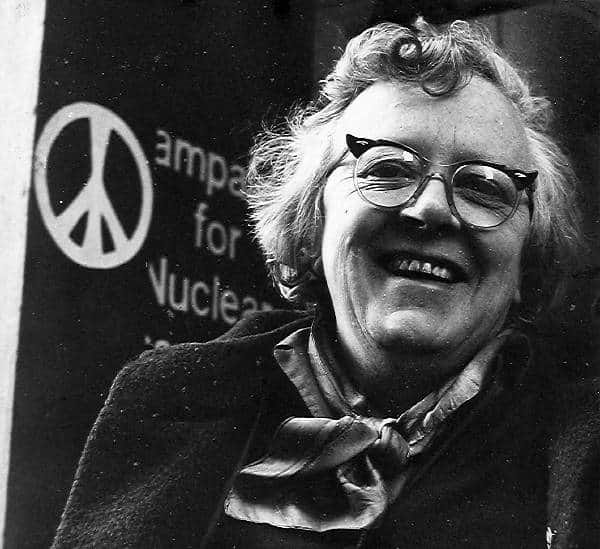
Canon John Collins and philosopher Bertrand Russell marched in the lead, catching the limelight. But the woman with the bullhorn, cigarette dangling from her lips, was the real brains of the Ban the Bomb movement.
Peggy Duff “would have qualified for the general’s rank in any army,” one founder of the Campaign for Nuclear Disarmament said. From 1959 to 1963, she organized the largest protests Great Britain had ever seen: Every Easter weekend, 40,000 to 150,000 marched four days from the UK’s nuclear bomb making facility in Aldermaston to Trafalgar Square. She twisted arms, mobilized unions, and lined up churches and schools to provide food and lodging along the 52-mile route.
It was not Duff’s first protest movement nor her last. Over the course of her career, she rounded up aid for civilian casualties of World War II, worked to eliminate capital punishment in Britain, led an international peace movement, protested the Vietnam War, and supported the Palestinian claim to an independent homeland. Uphill battles all.
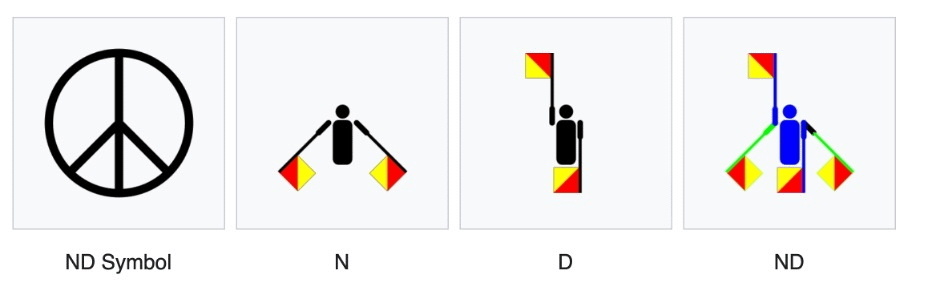
And though today the Atomic Doomsday Clock is closer to midnight than it has ever been, activists still march on the path she blazed. Nothing symbolizes her impact more than the CND logo: Fashioned after the semaphores for the letters N and D, it remains today the international symbol of peace.
Duff’s husband, a fellow journalist, was killed while covering World War II. She showed compassion for all victims of that war, including those in vanquished Germany. She joined Save Europe Now, which sent food and clothing to starving civilians in Germany and Austria and advocated for the repatriation of POWs. A widow raising three young children, “Campaigning seemed as good a way as any other of earning a living, and better than most,” she later said.
Even though the death toll at Hiroshima and Nagasaki was abhorrent to many, the United Kingdom leadership felt compelled to develop its own nuclear bombs. The British public was aroused in 1957 as the UK tested its weapons over Christmas Island, a coral atoll in the Pacific.
During some of the tests, islanders were taken out to sea to watch a Disney film. In others, they were huddled under a tarp. “We were just told to assemble, sit down and to put our fists in our eyes,” one woman told a researcher from Manchester Metropolitan University. “The officers were not with us, they had protective clothing and bunkers elsewhere.”
Author J.B. Priestley, whose radio broadcasts had rallied Brits during World War II, struck a chord when he wrote in the New Statesman, “Alone we defied Hitler; and alone we can defy this nuclear madness.” Catching the wave, Canon Collins, an activist Anglican priest, and Russell, a pacifist philosopher, formed the Campaign for Nuclear Disarmament to “renounce unconditionally the use or production of nuclear weapons.” They named Duff their Organizing Secretary.
“Organizers, since they are usually women or very young men, are expected, I suppose, to have husbands and parents to supplement their income,” anti-nuclear activist Mary Kaldor later wrote. “Peggy was a widow and was always very hard up. She lived very modestly in a tiny two-room flat in Albert Street. … The plastic bag which she used to carry her things when traveling is legendary.”
While she was busy organizing the Aldermaston Marches, Collins and Russell were busy quarreling over tactics. Russell argued for more visible, confrontational civil disobedience, and eventually broke from CND to form the Committee of 100. Thousands were arrested in sit-ins at military bases and throughout London. The Ban the Bomb movement gained traction. The Labour Party took a unilateral disarmament stand in 1960.
Ironically, the Cuban Missile Crisis took the wind out of the movement’s sails. The crisis was defused without nuclear war, and the public seemed to conclude that the arms race could be safely managed. A Nuclear Test Ban Treaty and growing concern over the Vietnam War also bled support.
Duff joined the International Confederation for Disarmament and Peace and traveled the world, speaking for unification of Vietnam, humane treatment of prisoners of war, and American concessions at the Paris Peace Talks.
In 1978, she compiled and contributed to essays proposing peaceful solutions to the Middle East conflict. In her “No More Blank Cheques” essay, she argued that the West’s unquestioning military support of Israel will “encourage and feed Israel intransigence, (and) is a major obstacle to a reasonable and durable settlement.”
A plan to position nuclear missiles in Western Europe to counter the Soviets reawakened the anti-nuclear movement in the ’80s. In the year before she died of breast cancer in 1981, she recruited 10,000 to the revived CND. She did not live to see some of the biggest protests the movement had ever seen: 250,000 in London and 3 million across Europe.
The cruise missiles were deployed anyway. “Peace through strength,” Ronald Reagan declared, and Europe fell in line.
Duff titled her book recounting her campaigns Left, Left, Left. While she saw initial successes, they always were followed by wrong turns to the right, right, right. Despite that, she saw long-term gains. “Many of the young people who inspired and organized the Vietnam campaigns in the mid-60s moved from a passionate opposition to the war to an examination of the societies which created and condoned the war.”
In a back-cover endorsement of her book, Noam Chomsky noted that her accomplishments “would easily merit the Nobel Peace Prize.”
But they didn’t.
Today, the Atomic Doomsday Clock shows 85 seconds to midnight. Nine countries have nuclear bombs and about 10,000 warheads lurk around the world. “Leaders of the United States, Russia, and China greatly vary in their autocratic leanings, but they all have approaches to international relations that favor grandiosity and competition over diplomacy and cooperation,” declared the Bulletin of Atomic Scientists, the keepers of the clock. “The rise of autocracies is not in itself an existential threat, but an us-versus-them, zero-sum approach increases the risk of global catastrophe.”
This year Duff’s organization, the CND, condemned the U.S. war on Iran. “Whilst Iran negotiated in good faith over its nuclear programme, the nuclear armed states of Israel and the US sabotaged these diplomatic efforts. It is US and Israel that are the nuclear threats.”
“I think we made people, and that includes statesmen, aware of the horror of nuclear war,” Duff said in 1971. “Nuclear weapons have not been used again since 1945, and there has not been a nuclear war so far.”
Fifty-five years on, Duff’s assessment seems more ominous than optimistic.
Sources
A U.S. nuclear bomb test on Amchitka Island, Alaska, in 1971 is a pivotal event in my historical fiction novel, Mission: Butterfly. My research led me to the Ban the Bomb movement and the little-known force behind that movement, Peggy Duff. Because Duff worked mostly behind the scenes, I had to search scattered sources, including The Radical Tea Towel, The Guardian, the Campaign for Nuclear Disarmament website, Wikipedia, and Newspapers.com.
The Bertrand Russell Foundation’s website provided historical context for the Campaign for Nuclear Disarmament, including Duff’s introduction to the book War or Peace in the Middle East?
The UK’s above-ground blasts over Christmas Island are starkly described by islanders in an article by Becky Alexis-Martin, a lecturer at Manchester Metropolitan University, in The Conversation.
As a teen, I proudly decorated my guitar case with a peace sign. In researching this essay, I discovered on Wikipedia its origin: English artist Gerald Holtom, who designed it for the Aldermaston Marches.
