

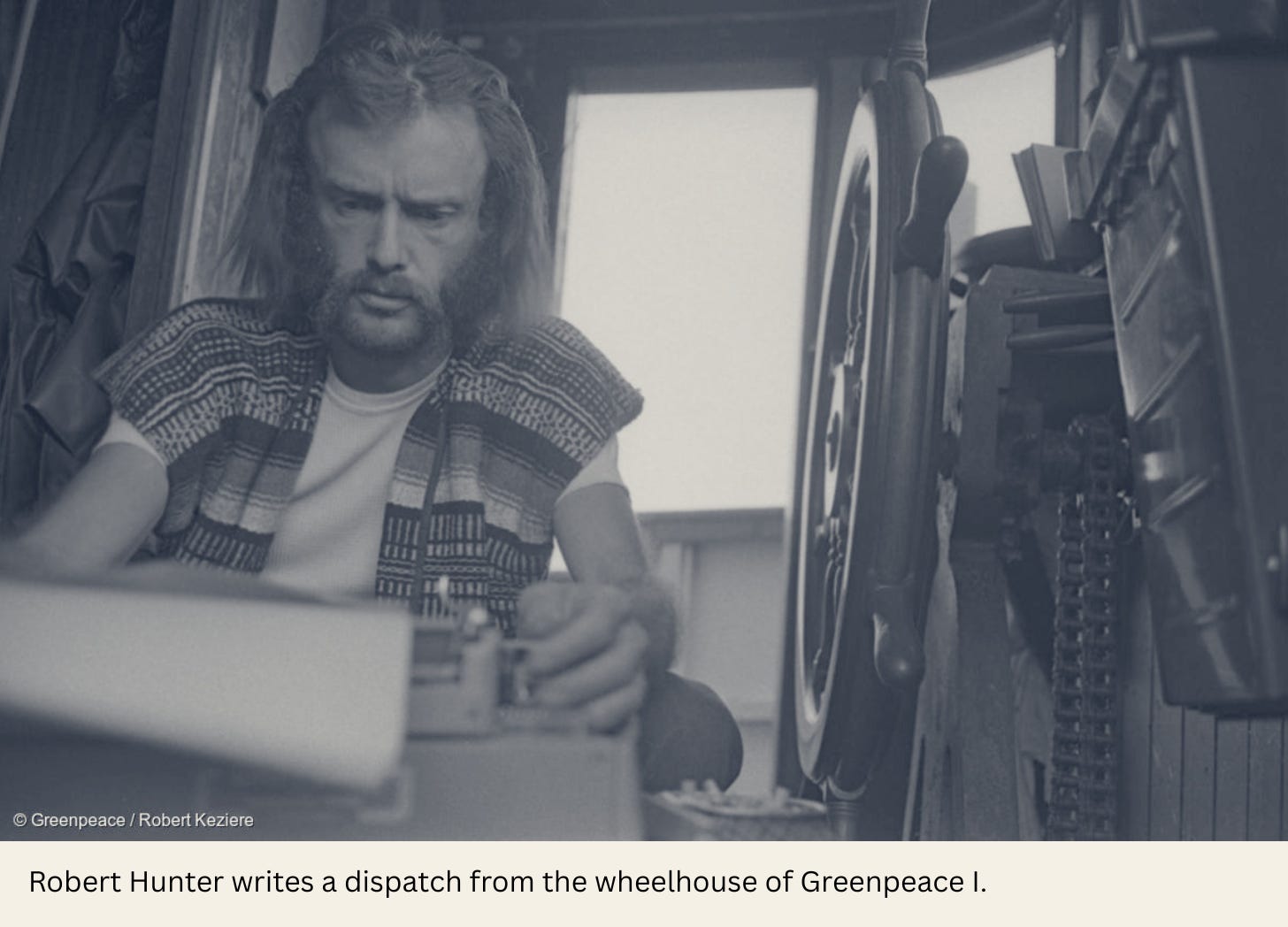
The dozen bearded, unbathed men argued furiously in the cramped galley of the halibut boat. The debate that had brewed for days came to a head, and each man lunged for the tape recorder microphone and the Wakefield King Crab hat that conferred the right to speak. Do they turn back for home, or do they brave stormy seas to anchor off an Aleutian Island, where a five megaton nuke awaited?
A poster of Richard Nixon, darts in his nose, looked on as Robert Hunter donned the Wakefield King Crab hat and argued to forge ahead. In the month the ill-equipped old boat had tossed in the North Pacific, he and other journalists aboard had raised international alarm over the U.S.’s plan to detonate the bomb on Amchitka Island, sitting on one of the most geologically unstable faults on the planet. (Just seven years earlier, Alaska had been devastated by the Good Friday Earthquake.)
They had to do more than raise awareness. They had to raise the collective consciousness, Hunter argued. They could anchor just outside the buffer zone, maybe motor a skiff ashore and put their bodies on the line. Whether they force America to back down or die in the trying, they would have set a “mind bomb” that would awaken humanity to the damage it was doing to the planet.
Hunter tended to frame the mission in New Age, almost mystic terms. He ordained shipmates ministers in the “Church of Ecology” all “in the spirit of Merry Prankster-type mindfuck, you understand.” He christened them “Warriors of the Rainbow.”
It might have been too much for the others around the table. To most, this was a PR battle they had won: look at the TV coverage. Even a few Coast Guard crew were moved to smuggle a supportive note to them. Besides, the U.S. kept delaying the blast and winter was coming. The boat turned back for Vancouver.
Hunter was crushed. Had he clowned around too much? Failed to make his point?
The underground nuclear bomb detonated a few weeks later, November 6, 1971. The worst fears were not realized: There were no leaks; the Earth’s tectonic plates held.
But a thousand otters washed ashore, their eardrums burst.
Hunter recalled that in the planning of the Amchitka voyage, “Somebody flashed two fingers as we were leaving the church basement and said, ‘Peace!” (Canadian ecologist) Bill (Darnell) said, ‘Let’s make it a Green Peace.’ And we all went Ommmmmmmm.” The chartered halibut boat, the Phyllis Cormack, was christened Greenpeace.
Hunter, who had worked his way up from copy boy to columnist at the Vancouver Sun, won a spot on the boat on the strength of his recently published book, Storming of the Mind. It called on ecologists “to heed Marshall McLuhan’s advice: take over the control towers of the mass communications system and deliver new images that will liberate people from their primitive tribal mindsets, creating a new global consciousness.”
He invented the term “mind-bombing”: “Instead of storming the Bastille, we’re storming the minds of millions of people. Instead of lobbing bullets and bombs, we’re lobbing mind bombs, revolutionary images that will explode in people’s heads.”
The Phyllis Cormack/Greenpeace was a Canadian vessel, so all the U.S. could do was monitor its voyage (the U.S. observed maritime law in those days). Hunter described a morning in which a Coast Guard Hercules surveillance plane buzzed them and a side door opened for a cameraman to shoot. The journalists aboard the boat returned fire.
“They took pictures of us for the record and we took pictures of them for the record, and it was a war between two motion picture studios making two completely different movies with completely different bad guys. It was a McLuhan-type war, a war of the icons, a public relations struggle,” Hunter recounted.
The voyage was mind-altering for Hunter, and he sought to bring his crewmates along on the trip. He read them passages from a book of purported indigenous legends compiled by a California naturalist and an Alaskan native, Warriors of the Rainbow.
“In it was a core legend that predicted a time when the Natives would be almost completely wiped out by the white man, and the forests would be chopped down and the water and the skies poisoned. At that time the Natives would rediscover their spirits and teach the white man how to live in the world without wrecking it. They would become Warriors of the Rainbow,” he wrote.
He thought he was making progress with his crewmates. “In a leaping flash of Group Mind understanding, we all connect with the idea that all life is interwoven, including us. We are all one. It is pure Zen thought coming out of pure Western technological thought – ecology is just the latest surge of science. For one moment, East and West come into phase, the great dichotomies breaking down, the void coming alive like an all-creating flame.”
But then the decision to abort. On its way home, the moody crew received an invitation from the Kwakiutl tribe to stop at Alert Bay, British Columbia. In a ceremony in the tribe’s Big House, under the “great wooden wings of the totems” that held the roof, they danced a dance to free them of their egos and were made honorary Brothers of the Kwakiutl. “Here I was … fresh (so to speak) from having seen abandoned whaling stations on the bone-strewn shores of the North Pacific islands, the ocean and sky almost empty, nuclear bombs being tested whose shock waves killed mammals en masse. … I was a changeling.”
He saw in his mates’ faces that, “’There might be something to this Rainbow Warrior thing after all.’ Maybe, if nothing else, we white-folk environmentalists and anti-nukers needed a defining myth.”
Greenpeace ships ever since have sailed under a Kwakiutl symbol of the Rainbow Warrior—graciously blessed by the tribe years later, after Hunter became aware he had appropriated it without permission.
“Bob Hunter and I find a seal 20 feet before the monstrous scarlet bow of the Arctic Endeavor. We hold our position with our backs to the ship.
A crewman yells, ‘You better move, boys, the old man isn’t one to think twice about running you into the ice.’ Bob yells back, ‘Tell the old bastard to do what he likes.’
The ship backs away. We think we’ve won this round. Then the Arctic Endeavor plunges forward, picking up speed. Still we look ahead. We feel her coming. We hear her coming. The vibrations tingle the soles of our feet. The ice trembles and cracks. Blocks of chunky ice tumble forward before the bow and nudge our feet.
The crewman on the ice screams to the ship’s bridge, ‘Stop her, cap, stop her. The stupid asses ain’t moving.’
The engines are cut and reversed. The ship slowly grinds to a halt, five feet behind our backs. I pick up the baby whitecoat to move it to safety.”
— Paul Watson interview in the Toronto Star, March 4, 1977
By the mid-‘70s, Hunter and Paul Watson had become TV icons of the Greenpeace movement, known for zipping a Zodiac inflatable boat between whales and explosive harpoons. They teamed up again to harass Norwegian and Canadian hunters who clubbed baby harp seals to harvest their white coats.
Daring an ice cutter was, “the sort of thing only done in combat, the kind of thing that binds guys together for life, long after the war is over,” Hunter later wrote. “At one point, we clasped hands, which is how we would have died if the ship hadn’t stopped.”
But whereas Watson wanted to save whales and baby seals, Hunter wanted to raise global consciousness.
Hunter, as leader of Greenpeace, preached nonviolent resistance. As he wrote in his book, The Enemies of Anarchy, violence, “diverts us from the real struggle, which is to attain a higher level of consciousness.”
But Watson chafed at the limitations. “I saw plenty of whales die when I was with Greenpeace,” he said. “And I was forced to watch frustrated and helpless as the whales screamed in agony and died in their own blood.”
Watson’s criticism of Greenpeace tactics wore thin. The board voted him out of the organization. In protest, Hunter resigned.
It is a testament to their friendship that Hunter mortgaged his house to help Watson buy a minesweeper he could ram into Pacific whaling vessels. It was the first in a line of Sea Shepherds that would be the scourge of whalers, gill netters, and poachers around the world.
After leaving Greenpeace, Hunter returned to journalism and his cabin in the woods outside Vancouver, “brooding darkly over my failings as a leader, a man, and a sentient being.”
But Watson lured him back into the fray.
In the summer of 1990, Hunter lashed himself to a winch on the bow of Watson’s Sea Shepherd II, Sony Handy Cam aimed at a Japanese drift netting ship that Watson intended to ram.
“All along, in the Olden Days, I had bought into passivism. It was a tactical thing, to be honest: outnumbered and outgunned, what are you going to do?
“But Paul had gone ahead and armed himself. And rather than agonizing any longer (as I had for years) over the correctness, over the moral and political correctness, of putting a big steel-tipped boot to some mass-biocide jerk’s head, I was savouring every second, urging Watson on.
“Fuck Gandhi! Let’s clobber these bastards.”
— Bob Hunter, Red Blood: One (Mostly) White guy’s Encounters With the Native World
Net-hauling equipment was damaged on two ships, and the third ship in the fleet fled, leaving its 40-mile-long net drifting in the Pacific, north of Hawaii. The “curtain of death” would entangle and kill any creature that tried to swim through it. Watson’s crew tied heavy metal machine parts to the net and sank it.
The captain of one of the Japanese drift netters demanded over the radio why “Greenpeace” had rammed his ship. “Because you’re killing too many dolphins, whales, and birds, and you’re taking too many fish. And you insulted us by calling us Greenpeace.”
Mind-bombing had doused consumers’ desire for white seal fur coats, and had forced a moratorium on whaling and drift-netting. Governments quit detonating nukes, passed environmental protection laws, and designated a day a year as Earth Day.
But consciousness had not been raised. It still was OK to exploit the planet, but be more careful. And if you leave the exploitation door ajar, the next thing you know baby seals are clubbed after their white fur begins to molt; drift nets are replaced with bottom-trawling nets that scrape the seabed bare; whale hunting is illegal except within territorial waters; greenhouse gas permits are traded like baseball cards.
We made the wrong turn.
Hunter had envisioned an all-encompassing change, a global consciousness, “that can think in terms of wholes instead of parts, that can see the world as a single life system vibrant in the vastness of the cosmos.” A world in which the divine is perceived “in every drop of rain,” in which death was seen as a process “of going back into the Earth to nourish Her and to go on being, in however transmuted form.”
Maybe his life story made him especially attuned to interconnectedness. The Warriors of the Rainbow book that “fell off the shelf” as he packed for the Amchitka voyage had been given him by an “Orthodox Jewish gypsy dulcimer maker” who said, “Here. This is for you. It will reveal a path that will affect your life.”
As a teenager, a Huron stranger saved him from freezing to death on a solo camping trip. Upon his mother’s death, his uncle revealed that her grandmother was Huron.
After he left Greenpeace, a member of the Kwakiutl tribe called him out of the blue and gave him a PR job for a different tribe. The two would team up to write an indigenous view of Canadian history, called Occupied Canada.
He found himself one night in the Canadian Rockies at a powwow, in deep conversation with a Metís “Earth Healer.”
“Alice’s eyes glint redly as she reminded me that all life is part of the one Life Force, grown from the same shift in chemistry during the planet’s infancy.” Even the rocks of the Earth are alive; “we can learn to soak up energy from them.”
“And I think how my Huron saviour showed me how to put my sleeping bag down in the ashes of a fire on the glacial moraine, and that’s what kept me alive as the temperature dropped. And that’s why I am here.”
They were participating in a powwow at a critical juncture in Canada’s reckoning with the legacy of colonization. The Charlottetown Accords, a bureaucratic marriage of indigenous and colonizer governments, were up for a vote. For the men who debated whether to join or fight, Alice reframed the issue: “the Earth is in trouble, the land is in trouble, and what needs to happen here on Turtle Island is a balancing.” Aggressive development and worry-about-it-later mentality had to be balanced by a “receptive, allowing, surrendering energy.”
The medicine man moderator shut her down: “Those who want to learn about feminist issues can attend the workshop.”
The powwow ended without resolution. The accords went down in defeat, and Canada’s reckoning continues to this day. And Hunter drew a dismal lesson from the experience: “We came to the pass on the Sacred Mountain, a place where we were supposed to meet our destinies, and there was nothing there except new and ancient struggles of power, strategic interests, ideologies, cabals, decadence, lust.”
This summer, Paul Watson and his Sea Shepherd Conservation Society are protesting renewed whaling in Icelandic waters. The owner of the last commercial whaling company in Iceland wants to kill 400 whales, even though he no longer has a market in Japan for them; even though Iceland’s veterinarians say the whales suffer for minutes or hours after being harpooned.
Iceland’s lawmakers have a plan: a whaling ban. But it can’t go into effect until the whaling company’s license expires in 2029.
Bob Hunter died of cancer in 2005. As inventive as he was in dreaming up mind bombs—spraying green dye on whitecoat seals, for example—it was his message of interconnectedness we should absorb. It’s not a question of saving “the environment,” but one of joining with the ecology of Earth.
Even in his teens, that is what Bob Hunter tried to do—commune with nature. Having survived that solo camping trip in the Ontario woods, thanks to the Huron stranger, he hiked back to the road: “Except for this strange frozen canal of asphalt winding through the forest, this could be any moment in the last few million years. That’s what I sought! To get out of my moment in time. To feel timelessness, or at least get a sense of what it might be like to experience existence in terms of epochs and eras and ages, instead of insignificant hours and days.”
SOURCES:
I discovered Robert Hunter while researching my novel Mission: Butterfly. I admired a hippie gonzo journalist who found a way to break out of the mainstream and make a difference. He plays a small role in the novel. I read The Greenpeace to Amchitka, his account of the first “Greenpeace” voyage that his editor rejected but was published 30 years later.
It’s too bad that Red Blood: One (Mostly) White Guy’s Encounters With the Native World is out of print. I read a library copy, then broke my Bezos boycott to buy a used copy. It is a funny, classic gonzo journalism account of his escapades that resonates today.
Warriors of the Rainbow, the compilation of indigenous legends, and Hunter’s The Enemies of Anarchy are available on Internet Archive.
A video of Watson’s and Hunter’s ramming of Japanese drift netters is posted on the Sea Shepherd Society’s website.
Photos and information were gleaned from the Greenpeace website, especially from a remembrance of Hunter by journalist Rex Weyler.
Every couple of weeks, I’m reminded why I keep my subscription to Newspapers.com up to date.
NOTE: I boycott Amazon, so all book links take you to Bookshop.org, where a portion of every purchase is shared with independent bookstores.
