

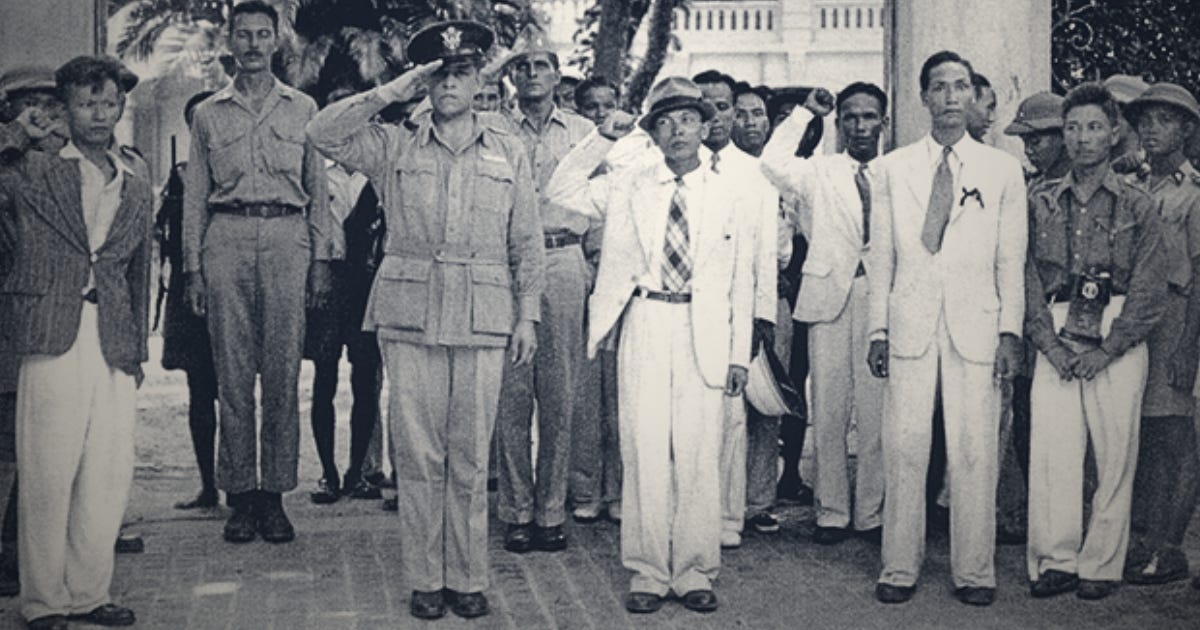
Public domain / Office of Strategic Services
General Võ Nguyên Giáp was misty-eyed as his ragtag military band played the final bars of the Star Spangled Banner. He cast a sidelong glance at the Army officer standing next to him. The officer stood at rigid attention, saluting. He seemed suitably impressed.
Grinning broadly, he shook the American’s hand and said, “This is the first time in the history of Vietnam that our flag has been displayed in an international ceremony, and our national anthem played in honor of a foreign guest,” Giáp told Patti. “I will long remember this occasion.”
Army Major Archimedes Patti would long remember this day, too. With regret.
Patti had orders to keep his nose out of politics. That was a tall order here in Japanese-occupied Vietnam, August 1945. Nagasaki and Hiroshima had been leveled by atomic bombs just weeks earlier. The emperor had surrendered, but terms had not been settled. Patti’s small team landed in Hanoi to secure the release of Japanese-held POWs.
Several other agents of the Office of Strategic Services (the forerunner of the CIA) were conducting similar “mercy missions.” The one in China had gone badly. Patti’s counterpart had gotten mouthy with a communist patrol and was bayonetted and shot to death. He would someday be called the “first casualty of the Cold War” and a right-wing organization formed in his name, the John Birch Society.
Patti’s orders to stay out of politics were complicated by … politics. The French wanted in on this mission, but they were despised by the Vietnamese and barely tolerated by the Japanese. They forced the son-in-law of a former prime minister onto his team. And just as he got off the plane, the entitled Frenchman started to make trouble. He demanded a car. He wanted to be driven to the radio station to make an announcement of liberation. The Japanese commander, who was still making sense of Patti’s request to surrender, was irritated.
The whole thing got settled when the Frenchman was offered the opportunity to stay at the former French governor’s “palace.” Once there, the Japanese set a guard, and he hadn’t been seen around town since.
Patti and his team were given a villa formerly occupied by the French finance minister. It was at the gates that General Giáp had brought his welcoming committee.
A color guard marched by, bearing the flags of the United States, Soviet Union, China, and the new flag of the Democratic Republic of Vietnam. It was a symbol. A wish.
Giáp’s men had received a hero’s welcome when they marched uncontested into the city a few days earlier. The Japanese retreated to their camp, and a joyful citizenry banged pots, stripped the air-raid covers off streetlamps, and hung banners praising the Viet Minh. Many in Saigon had secretly supported the resistance guerrillas during the war and now counted on them to evict the French.
Patti met the Viet Minh’s leader, Hô Chì Minh, in a café on the China/Vietnam border four months earlier. The OSS’s French contacts within Vietnam were not reliable. Hô’s people had rescued and smuggled downed Allied pilots out of the country. They were communists, but as long as they provided good intel, Patti didn’t mind.
The 55-year-old Hô was deathly pale, emaciated, and smoked like a chimney. He spoke fluent English and French, having spent years working kitchens in Paris and New York. And he spoke a lot: About the famine that claimed a million or more lives, which he blamed on Japanese neglect; about French absentee landowners and merchants who improverished and mistreated laborers, and about onerous quotas on purchase of French alcohol and its licensing of the opium trade.
“Besides the freedom to get drugged, to get drunk, and to pay taxes, the Indo-Chinese have no other freedom,” he said. “Are the Allies really fighting for world freedom and democracy as they solemnly said in their official declarations? Or do they fight simply to save French selfish colonial interests?”
Patti, speaking for himself, was fighting for freedom and democracy. But he couldn’t speak for those at higher pay grades. His OSS dossier indicated Hô had been pitching independence as far back as the end of World War II, to no avail. Will things be much different at the end of this world war?
The history lesson over, Hô quickly agreed to help the Allies. He hated the Japanese. A million or more Vietnamese starved to death under their occupation. He hated the French more, but first things first.
The deal was made, and the Allied brass were happy. The communists’ intelligence helped the Allies disrupt Japanese communication and supply lines in the final months of the war.
Patti noted that the marching honor guard wore mismatched uniforms, and many bore swords, axes, and the odd stolen Japanese rifle. But a few carried American M16s acquired from the special forces team that had trained them over the last few months.
He took stock of their general. Giáp was about his age, thirties. Small and swimming in a cream-colored suit with a loud plaid tie. Probably “liberated” from a French haberdashery during his troops’ marauding reclamation of the city. He looked affable today, but Patti had heard he could be fierce. “Snow-covered volcano,” the French called him. They had created him: His wife and her sister were killed in their prisons.
The French colonials in Hanoi irritated Patti. They insisted on calling Vietnamese “Annamites,” a pejorative that offended the Vietnamese. They blamed him for delaying the release of French POWs. But Hô held the keys and was understandably reluctant to unleash French soldiers onto the streets of Hanoi. His caution proved warranted: When Patti’s counterpart in Saigon, a British officer, released the French POWs there, they sacked the city.
Patti’s sympathies tilted toward the Viet Minh. His dispatches to OSS headquarters advocated for Vietnamese independence on a moral level: Hô’s demands were “few and simple[:] Namely limited independence, freedom from French rule, [and the] right to live as free people within [the] family of nations.” On a practical level: “From what I have seen, these people mean business. The French will have to deal with them. For that matter, we all will have to deal with them.”
On Sept. 2, he joined a throng in Ba Đình Square, where chants of “Độc lập! Độc lập!” (Independence! Independence!) stilled when Hô Chì Minh mounted the dais. He read the country’s Declaration of Independence, which began: “All men are created equal. They are endowed by their Creator with certain inalienable rights, among these are Life, Liberty, and the pursuit of Happiness.”
When Lieutenant Dan Phelan parachuted behind the lines to help train Giáp’s troops the previous May, he met Hô, “an awfully sweet guy.” Hô pestered Phelan for the exact words of the U.S. Declaration of Independence. “I was a normal American. I couldn’t … but all he really wanted was the flavor of the thing. The more we discussed it, the more he actually seemed to know about it than I did.”
In August, Hô pressed Patti for the wording, then read his draft of the Vietnamese Declaration. He clearly had the wording down pat. “I was becoming uncomfortably aware that I was participating—however slightly—in the formulation of a political entity and did not want to create an impression of participation.”
Hô Chì Minh was playing his last cards.
The echoes of Thomas Jefferson’s words were not meant for the cheering crowd in Hanoi. Historians speculate they were meant to signal to Washington that there was common ground to explore.
But it was for naught. On the same day Hô was reading the Declaration in Ba Đình Square, U.S. General Douglas MacArthur was accepting the Japanese surrender in Tokyo Bay and giving French General Philippe Leclerc the green light to invade Vietnam.
“Bring in troops, more troops, as many as you can.”
America had made the wrong turn.
On his last night in Hanoi, Patti had dinner with Giáp and Hô. He was moved by the emotion in their thanks and farewell. “At the same time, I knew they were taking advantage of this last evening to put themselves and their cause in the best possible light,” Patti wrote later. “They were isolated from the communist world, they were surrounded by self-interested powers, and the few Americans within their view were the only ones with whom there was a rapport. Americans were the ones who understood the difficulty of achieving and maintaining independence.”
Hô had written eight letters to President Truman, asking him to honor the promise of self-determination made in the Atlantic Charter. But the charter was not a treaty; just some principles jotted down by Winston Churchill and Franklin Delano Roosevelt. FDR was dead, and Truman was more concerned about rising communism than declining imperialism.
France was left to fight it out with the Viet Minh, though the United States footed 78 percent of the bill. When Giáp defeated the French, the hot potato was tossed to the United States. Having driven Hô into the arms of the Chinese and Soviet Union, the U.S. no longer saw Vietnam as a seeker of self-determination, but as a communist domino about to fall.
Thirty years and 2 million deaths after Giáp brought an honor guard to the Americans, he defeated them and won independence for Vietnam. The CIA finally allowed Patti to write his memoirs. He had spent the rest of his government service in emergency preparedness, out of the loop as the Vietnam War raged. So much so that the consultants who researched the Pentagon Papers didn’t interview him.
“Ho Chi Minh was on a silver platter in 1945,” he said in an interview. “We had him. He was willing to be a democratic republic, if nothing else. Socialist yes, but a democratic republic.”
Patti went looking to see what happened to the dozen or so reports he had sent to Washington. The OSS Chief of Registry, Julia McWilliams (better known as Julia Child), assured him she had forwarded them.
He found them in a dusty cabinet at the CIA.
Unopened.
Sources
It was agony to cut Archimedes Patti from my novel to true up the timeline. A World War II spy. A confidant of Hô Chì Minh. What if he and Robert McNamara had gotten together? This amputation is what gave me the idea to write this series of essays; his story had to be told. I don’t remember how I first heard about him, but I do know my first source was unedited interview footage from a 1981 PBS documentary, “Vietnam: A Television Story.” You can find an edited interview done for the Vietnam Reconsidered conference in 1983 here.
I have always admired Robert McNamara’s forthright acknowledgment of error in Vietnam. I re-read his In Retrospect: The Tragedy and Lessons of Vietnam.
That sent me down some rabbit holes, but the most fruitful was The OSS and Hô Chì Minh: Unexpected Allies in the War Against Japan by Dixee Bartholomew-Feis.
I got a glimpse of Vietnamese life in that time period through the excellent memoir The Sacred Willow: Four Generations in the Life of a Vietnamese Family by Mai Elliott. She immigrated from Vietnam and became one of the researchers for the Pentagon Papers. Speaking of which, even though I was greatly incensed by Nixon’s attempted censorship, I never read the Pentagon Papers until now.
The wrong turns this series describes are all of a piece to me, and their contribution to the climate crisis is at the crux of my novel, Mission: Butterfly. Rubber and the Making of Vietnam by Michitake Aso recounts how rubber trees were transplanted from Brazil to Southeast Asia, and how damaging plantation agriculture and monoculture is to the earth.
Sheldon Tsu, an agricultural economist, was one of the few non-military members of the American mission in the ‘50s. When I read his report on launching co-op farms in Vietnam, I was cheered to know there were some Americans truly helping the Vietnamese. I made him a fictionalized character in my novel.
If you want to follow me further down rabbit holes, here are some excellent books: Vietnam: Lotus In A Sea Of Fire was written by Thích Nhat Hanh in 1967 (he is a character in my novel). The Red Earth: A Vietnamese Memoir of Life on a Colonial Rubber Plantation is a gruesome account by Tran Bu Binh, who became a member of the Viet Minh. The Wretched of the Earth by Frantz Fanon is 60 years old, but the techniques and scars of colonialism remain depressingly salient.
Articles in Scientific American gave me a sense of the excitement surrounding wartime technological innovation. Articles in The New York Times gave me a sense of how little Americans cared about what was happening in “Indo-China.”
NOTE: I boycott Amazon, so all book links take you to Bookshop.org, where a portion of every purchase is shared with independent bookstores.
More at SteveKrizmanAuthor.com

The Wrong Turn is an essay series about the people who saw it coming and said so. All of them were right. The essays grew out of my research for Mission: Butterfly, a climate-fiction novel set in mid-century America. New essays every other Tuesday.