

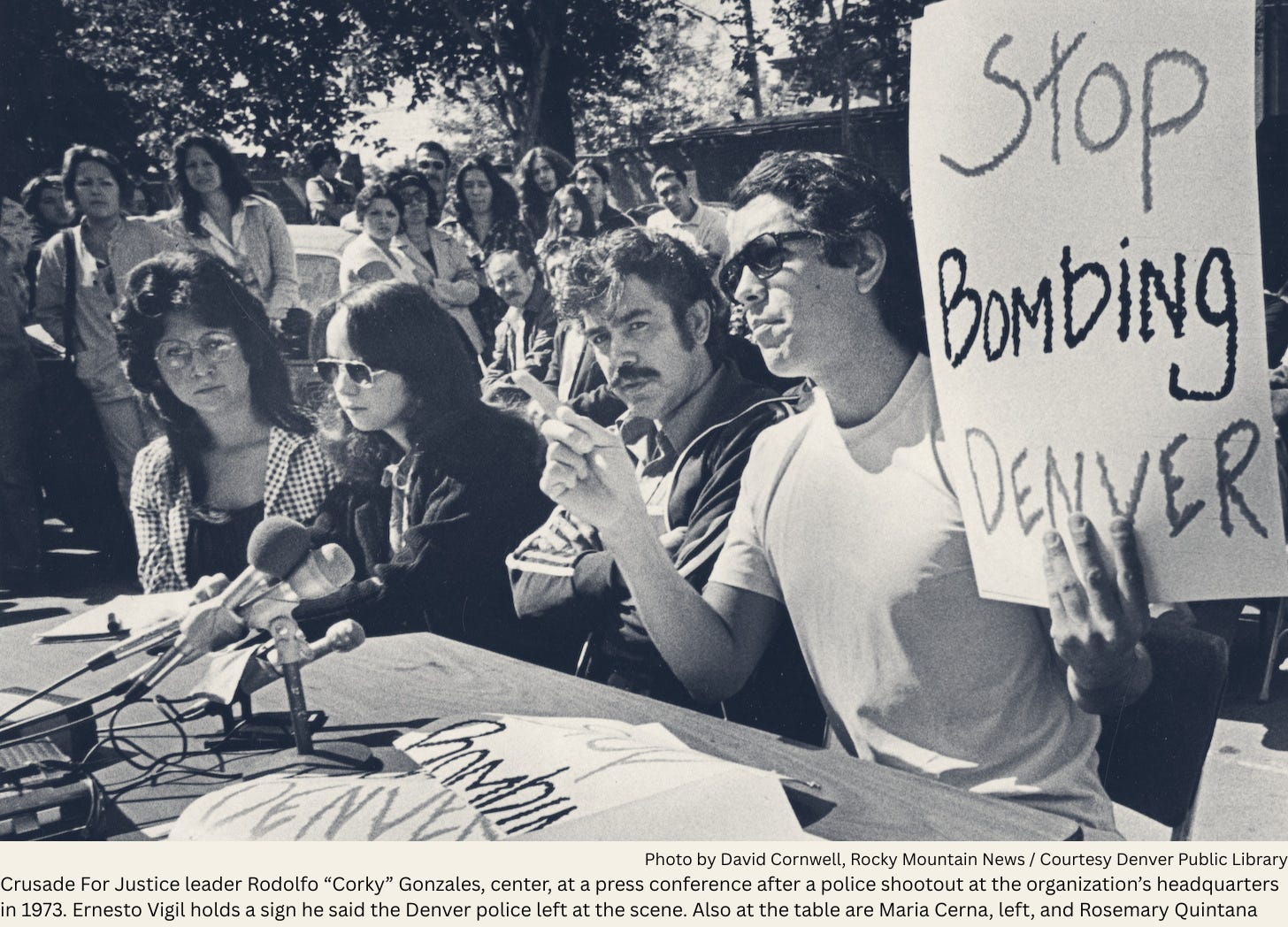
On the morning of March 17, 1973, Rodolfo “Corky” Gonzales took the Denver police chief through his Crusade For Justice headquarters. See? No guns. No bombs.
They walked outside, past the blood-stained concrete where a Crusade member had been shot and killed by police. Down the block to survey the massive hole blown in one of the Crusade’s buildings. City officials kept everyone away. Too dangerous. It was torn down before the cause of the blast was determined.
“Suspected cache of dynamite” would be the phrase used by newspaper accounts that day and forevermore.
Gonzales said he was manhandled by police when he arrived early that morning. The shooting had stopped, but an angry crowd had gathered. He learned quickly that Luis “Junior” Martinez was dead. He was devastated. He’d known Junior since the boy started bringing his North High Black Berets to all the Crusade marches. He grew into a gifted dancer and taught students in the Crusade’s Ballet Chicano Aztlán. He was only 20.
Another rising young leader, Ernesto Vigil, was shot in the back. He should be in the hospital, but the cops hauled him to jail from the ER, accusing him of firing on officers. Did Ernesto know Junior was dead? They were buddies, had survived that god-awful riot in LA together.
A young man somehow survived the blast that took out the wall and roof of his apartment. Police said they “smelled” dynamite, but wouldn’t let him or anyone else close enough to investigate.
I was finishing my junior year in high school that spring, licensed to drive, and free to party. There was a night when the police chased us from house to house, park to field in what we came to call the “Mobile Kegger.” Just white Catholic boy hijinks.
I don’t remember taking much notice of the St. Patrick’s Day shootout at the Crusade for Justice. If I did, I’m sure I didn’t have much sympathy for the Crusade’s side of the story. The media had made clear they were a dangerous, militant bunch. I have an early memory of being stomach-churningly scared while helping my Auntie Joyce set up chairs for an event in the Crusade meeting hall. The frightening media narrative had wormed all the way down to 10-year-old me.
I certainly don’t recall reading that three of the four Crusade members accused of assaulting police that night were acquitted at trial.
Corky Gonzales wasn’t always the villain. He got good press when he was a rising star in the pro boxing ring in the ‘40s and ‘50s, and then when he delivered brown votes to Democratic candidates in the ‘50s and ‘60s. It began to sour when he broke from the Democratic Party because a mayor reneged on his promise to create an independent police review board. The mayor fired him from his city post in 1965, and 1,000 people showed up at City Hall to protest. “This meeting is only the spark of a crusade for justice, which we are going to carry into every city in Colorado,” Gonzales told them.
His speeches fired people up, especially the young, who were fed up with schools that belittled their culture, with police who harassed them, with a Vietnam draft that seemed rigged against them, and with a Civil Rights movement that paid them little attention. Gonzales bottled all that frustration, put it in context of a centuries-old struggle, and issued a stirring call to action in—of all things—a poem.
“There are no revolutions without poets,” Corky Gonzales once wrote. His epic poem “Yo Soy Joaquín” was a revolution starter. When he published it in 1967, it was reprinted in Chicano media across the country. It was tacked to telephone poles in the barrio. It was performed dramatically in film and on stage.
Yo soy Joaquín,
perdido en un mundo de confusión:
I am Joaquín, lost in a world of confusion,
caught up in the whirl of a gringo society,
confused by the rules, scorned by attitudes,
suppressed by manipulation, and destroyed by modern society.
My fathers have lost the economic battle
and won the struggle of cultural survival.
And now! I must choose between the paradox of
victory of the spirit, despite physical hunger,
or to exist in the grasp of American social neurosis,
sterilization of the soul and a full stomach.
The poem has the sweat, the punch, and the howl of the boxing ring. It packs tight, vivid scenes to speed through the history of the Aztecs, the Conquistadors, the mestizo, and the Mexican freedom fighter.
Juaquín is a reflection of Gonzales himself, a man who knew he and his people deserved more than the Anglos were dishing out. A man who worked through the system, found it corrupt, and set out on a principled path. A man who had seen too many police beatings and vowed to make it stop.
Gonzales’ villainous portrayal began with his arrest on the steps of Denver West High School in 1969.
About 150 Chicano students, including one of his daughters, Nita, gathered at the door to demand a sit-down with the principal to discuss bias in curriculum and school policy, and a social studies teacher who disparaged what Chicanos ate and how they dressed. Gonzales was there to egg them on or guide them, depending on your point of view.
He became enraged when a phalanx of cops shoved the kids down the steps, one dragging Nita by the arm. Gonzales pulled Nita away from the cop, and then he was swarmed and cuffed. The West High Blowout had begun.
“I saw young people running in all directions and people screaming,” Gonzales testified later. “Little girls slammed against cars and dragged by the hair.” A police helicopter hovered overhead. Helmeted cops sprayed Mace liberally, even into the paddy wagon where teens sat cuffed.
The police asked the City Council for authority to make more arrests in such protests. The Denver Post editorial board accused Gonzales of “Hispanic racism.” The school district vowed to update its history curriculum and transfer the racist teacher to another school.
The affair receded to the back pages, and there was little fanfare months later when Gonzales and all but one of the other protesters were acquitted by juries. TV news footage shown at trial contradicted the police story.
The week after the blowout, Gonzales held the first of his annual Chicano Youth Liberation Conferences, each attracting thousands of high school students and young adults from throughout the Southwest. Here, they learned that American history did not begin at Jamestown. They learned to dance, sing, and play the music of their people. This is where Gonzales’ Plan Espiritual de Aztlán was born.
Aztlán was a place on the map: The Mexican border before it lost the war with the United States in 1848. Gonzales made it a metaphor for the culture that was lost to European conquest, one that must be reasserted. A “nation” of Aztlán might include the unlikely reclamation of land stolen in violation of a treaty, but mostly it envisioned a unified people who return to the ideals of family and communal sharing of resources.
Gonzales put 21-year-old Manuel Martinez in front of the media to explain. Martinez, one of those arrested and acquitted in the West High Blowout, had become notorious for the brilliant portrayals of Aztlán he painted on walls throughout the city. “Our people are as deeply rooted in this land as any tree … Nationalism is humanism and all these things lead to liberation.”
A Denver Post editorial columnist marveled at young Chicanos’ embrace of Gonzales’ “Yo Soy Joaquín” and his vision of a nation of Aztlán. “His heroes in the poem tend to be warlike, hence it is doubtful whether contemporary Hispanos can draw many lessons of practical value,” he sniffed.
The media covered--and the FBI fretted--over Gonzales’ support of activists in New Mexico who occupied federal lands, asserting rights under the Treaty of Guadalupe Hidalgo. Little was written about the daily work of “nation building” going on at Crusade headquarters in Denver: providing assistance in housing, jobs, and social services; supporting performance groups, and running a bookstore and art gallery.
Of the Crusade’s many projects, the one that consumed the most resources and would last the longest was its K-12 school, Escuela Tlatelolco. Classes were taught in Spanish and English, with a Chicano-influenced curriculum heavy on the arts.
As the public portrayal of Gonzales grew more sinister, J. Edgar Hoover put him on his Rabble Rousers Index. “There seems to be no question that his activities pose a threat to the internal security of the United States,” a Feb. 9, 1968, memo states. A foot-thick stack of redacted FBI reports reveals a years-long push from Washington to keep tabs on Gonzales and the Crusade, even though the Denver office often reported back that there was no there there.
The FBI memos acquired under the Freedom of Information Act also show that two days before the St. Patrick’s Day shootout, the FBI issued a bulletin to its Western field offices to be on the lookout for activists traveling to support the Native American occupation of Wounded Knee. The Crusade was mentioned in the memo, which concluded: “The object is to make lawful arrests as far from Wounded Knee, South Dakota, as possible.”
Crusade members had a feeling they were being watched when Gonzales was arrested in 1970 at the Chicano Moratorium Against the War in Los Angeles. Three were killed in that melee, including a Chicano reporter for the Los Angeles Times who was shot in the head by a teargas cannister fired from a launcher.
Gonzales was scheduled to speak to the 30,000 in attendance when the LA Sheriff declared an unlawful assembly and started lobbing teargas at the stage and then into the buses that protesters tried to flee in. The Crusade delegation piled onto a flatbed truck to escape. A police helicopter tracked them until they were stopped at a roadblock.
“Look for Corky. He’s the one with the mustache,” they heard the cops say. That description scarcely narrowed the field of suspects, but they finally found Gonzales in the cab. There was a gun under the seat and $370 in cash in his pocket. The money was for the group’s travel expenses, but police suspected robbery.
Gonzales was convicted of a gun violation and served 29 days in jail. It was the only time Gonzales was ever convicted of a crime, despite his many arrests by the Denver police.
The Crusade was ever on the Denver police’s prime suspect list, especially when several bombs turned up in the early ‘70s. Thirty-eight Denver school buses were destroyed. Dynamite was tossed or mailed to businesses, politicians, and police. White supremacists were emergent, opposed to busing and the Civil Rights movement. But still, the Crusade was the first thing police thought of. Ironically, the only bombs that actually exploded killed Chicanos.
Two Crusade members faced bombing charges and won acquittals at trial. A third was acquitted of state charges when the defense cut the police informant’s story to shreds, but was convicted of a federal explosives charge.
The bombings and attempted bombings have never been solved, including two car bombs that killed six Chicano activists in Boulder in 1974. In that case, the authorities figured there was nothing to solve. Denver District Attorney Dale Tooley summed up their thinking: “The gang that couldn’t shoot straight,” he wrote in his memoir, “apparently could not tell red wires from green ones.”
Gonzales fought against the narrative when the Connecticut State Police and the FBI issued all points bulletins in 1976, claiming he and the American Indian Movement were armed with M16s and rocket launchers and planned to “kill a cop a day.” The report was fabricated, as documents released under the Freedom of Information Act would later reveal.
Gonzales, whose Crusade was bleeding money to fend off the bombing charges, sued the Connecticut police for damages. “I believe we are sliding backwards,” he said in a deposition. “I don’t think (the memo) was used so much to stop, to stop my credibility, but I think it was used to have me assassinated, in a sense, murdered by proxy.”
The judge threw the case out, saying the defendants had governmental immunity.
With its image in tatters, the Crusade lost human and financial support to a growing list of government and nonprofit groups that were taking on Chicano causes. Gonzales took to criticizing Chicano leaders—even Federico Peña, the city’s first Chicano mayor—as being sellouts, “Tied to the umbilical cord of the establishment, capitalism, and the two-party system.”
Refusing to take grants from the government, the Crusade struggled to keep its day care center, ballet, legal defense, newspaper, social services, and prisoner rights programs afloat. Newspapers began to refer to him as the “militant civil rights leader of the ‘60s,” even as he led efforts in the ‘80s to build health and recreation centers in the Chicano community, to rename city parks to reflect their neighborhood culture, to allow Spanish to be spoken in schools and the public, and to demilitarize the police.
In the end, Escuela Tlatelolco was all that survived, with Gonzales’ daughter Nita Gonzales as principal. Even that fell prey to the “umbilical cord of the establishment.” In a last-gasp effort to keep it afloat, Nita Gonzales accepted Denver Public Schools’ money in 2004 and “almost lost our soul.” When the district pulled the funds in 2016, they lost the school. It closed the next year.
The police, the FBI, and the mainstream media made the wrong turn. They propagated a narrative of violence that buried the vision of Aztlán. Culture became a battlefield. Spanish deemed un-American. Sixty-one percent of Coloradans voted in 1988 to make English the state’s “official language.” Police brutality continues, with the city paying millions in settlements in the George Floyd protests alone. The Denver school district in 2024 admitted that Chicano students are not getting an equal education.
But now that I understand it, I see sprouts of Aztlán today.
Mia Martinez Lopez is the principal of Denver’s West High School, where Spanish is freely spoken these days. Her father was among those arrested and acquitted of police assault charges at the 1969 West High School blowout. Now, Emanuel Martinez’s murals are commissioned by councils, featured in Chamber brochures, and hang in the Smithsonian.
Serena Gonzales Guttierez, Corky’s granddaughter, is a Denver City Councilwoman, currently leading an effort to decriminalize poverty.
Each summer, high schoolers from around the country come to Denver for arts and culture education, an echo of the original Chicano Youth Liberation Conference.
Gonzales told an interviewer in 1985: “I would say the movement’s not dead. I might say it’s resting. And the emergencies that come about will bring us together. And there will be a resurgence, a new renaissance in the Chicano movement.”
Gonzales remained in fighting shape until he suffered a heart attack while driving in 1987. A brain injury slowed him down. Diagnosed with congestive heart failure in 2005, he checked himself out of the hospital and died days later, as he wished, among his friends and family.
SOURCES
Ernesto Vigil wrote a meticulously sourced and footnoted history, The Crusade For Justice: Chicano Militancy and the Government’s War on Dissent. He also entrusted boxes full of FBI memos acquired under the Freedom of Information Act to the Denver Public Library. I spent many hours in the library’s Special Collections and Archives Department. He acknowledges in the book’s foreword that a grant from the Gonzales family enabled him to devote time to the research. His point of view as a participant in the Crusade’s history is obvious, but he provides documentation to support his facts.
Juan Haro, another Crusade leader, wrote The Ultimate Betrayal: An Autobiography, also found in DPL’s Special Collections and Archives Department. He was acquitted of one of the bombing attempts but convicted of a federal charge of possessing an explosive device. His lawyer, Stan Marks, told me he would have beaten the federal charge if the cops hadn’t hidden their informant’s rap sheet. Haro returned to Denver from prison, angry that the Crusade did not pay his legal bills. Marks said, “all I got was a tank of gas once a week at Haro’s gas station.” In his book, Haro says Gonzales had begun running the Crusade for his personal enrichment and that he was the one who set him up in the bomb plot. The book in DPL’s Special Collections includes an exchange of letters between lawyers for the Gonzales family and the book publisher. I could not tell whether the publisher acceded to demands to cease printing the book.
I’ve read “Yo Soy Joaquín” four or five times. It’s brilliant. I spent hours looking up Gonzales’ historical references, filling in the gaps in my education.
In 2000, Corky Gonzales compiled his essays, speeches, poems, and plays in Message to Aztlán. There, I found the depth of his vision, a welcome contrast to the combative quotes that made the newspapers.
I read hundreds of articles in DPL’s Rocky Mountain News and Denver Post archives. What wasn’t covered was interesting. For example, the papers did not cover testimony in the first three St. Patrick’s Day assault cases. But when Vigil’s case came, and the police were down 2 cases to 1, both newspapers covered every day of the trial to see if it would be a tie or a blowout. “Jury Acquits Vigil In 30 Seconds” was the Rocky Mountain News’ front page headline.
Daniel Salazar created a documentary, After Juaquín, which aired on local public television in 1985 and has since been uploaded to YouTube here. His interview with Gonzales at the end of the Crusade’s run portrays a man aware of his early impatience and at peace with what was accomplished.
I consulted The COINTELPRO Papers: Documents From the FBI’s Secret Wars Against Domestic Dissent by Ward Churchill and Jim Vander Wall.
