

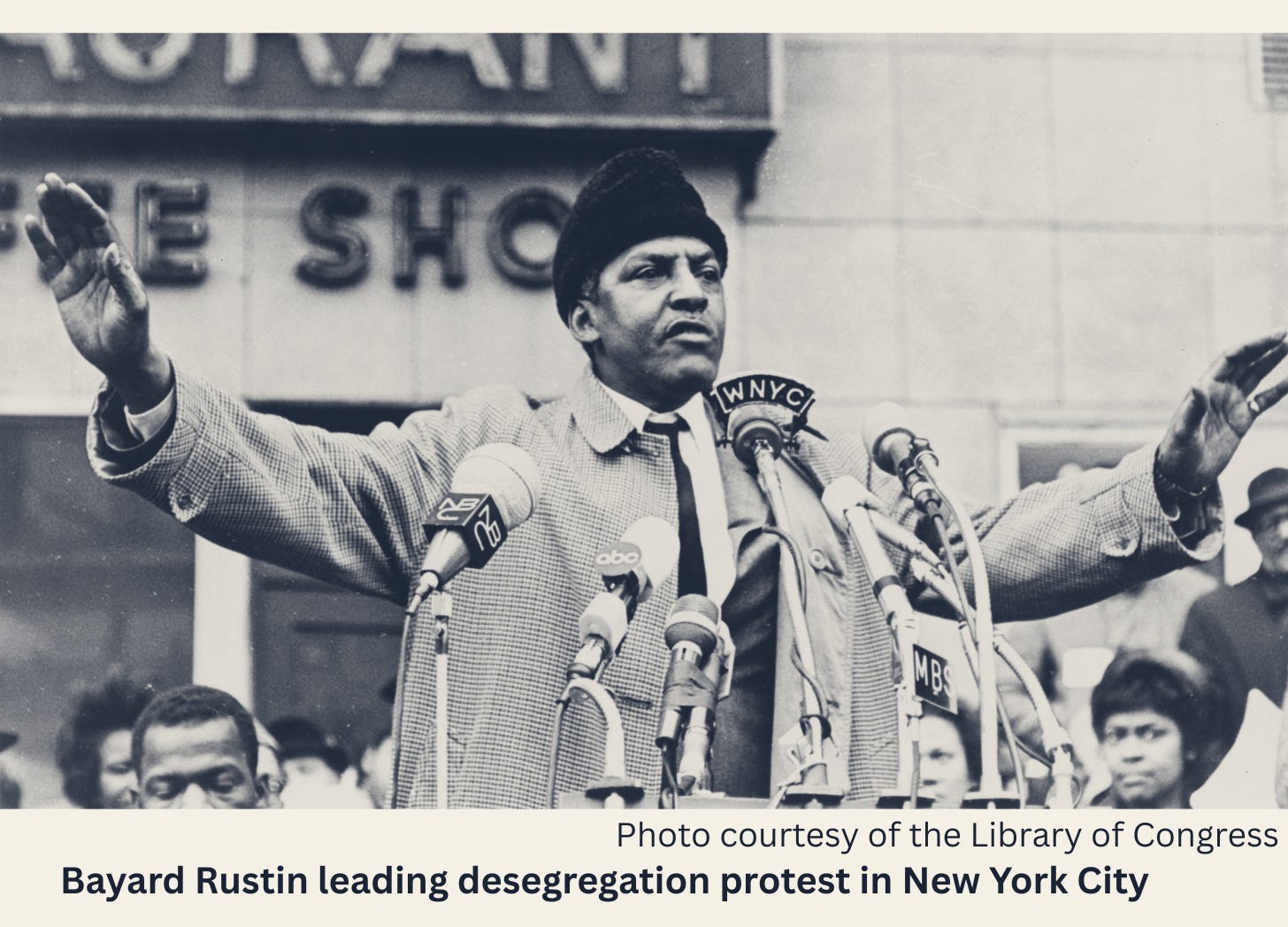
“Captain Jones” waved the newspaper clipping and glared into the face of the new man on the chain gang. “You’re the one who thinks he’s smart. Ain’t got no respect. Tries to be uppity. Well, we’ll learn you. You’ll learn that you got to respect us down here. You ain’t in Yankeeland now.” Then he thrust a pick into the Black man’s hands and punched the prisoner next to him.
For 22 days in 1949, Bayard Rustin shoveled ditches and patched North Carolina’s roads, shackled to other prisoners 10 hours a day, six days a week. He saw men hung by their wrists for days, left in holes with nothing but crackers and water.
How would a Quaker trained in Gandhian nonviolence respond?
He would talk to Captain Jones about how to “improve relations on the job.”
“He’ll kick you square in the ass,” one inmate warned. The gang held their breath as Rustin asked for a moment of the Captain’s time.
“I suggested that perhaps I was really the one who deserved to be beaten in the face, if anyone did,” Rustin later wrote. “I said that I was willing to work as hard as I could and that if I failed again at my work I hoped he would speak to me about it and I would try to improve.”
The Captain stared at Rustin a few moments, then turned to a guard and muttered, “Well, I’ll be goddamned.” Turning back to the anxious men, he shouted: “Talk ain’t gonna git that dirt on the truck. Fill her up.”
But as the work day ended, the Captain called the chain gang together. “This Yankee boy ain’t so bad. They just ruined him up there ‘cause they don’t know how to train you-all. But I think he’ll be all right and if you all will help him I think we can learn him.”
Rustin did learn. He learned that the first thing prison does is strip men of their self-respect. They were shaved bald and given caps to protect them from the sun. Then told to tip the caps when addressing the guards. Rustin modeled nonviolent resistance by refusing to wear a cap rather than debase himself. When the men followed his lead, the Captain could only sputter.
Rustin learned that when you treat men like animals, they act like animals. They turn on each other, steal from each other. When stamps and writing paper were stolen from his lockbox, he set it out, opened, and said the food and supplies he received from supporters on the outside were available to those who needed them most. Soon, others contributed treats, cigarettes, and other surplus items to the “community kit.” Theft declined overall.
In a farewell letter to the Captain, Rustin wrote: “Never having done similar work before, I am afraid I was not very apt, so all the more I want to thank you for all the help you gave me on the job. I feel that I learned a great deal.”
“Well, we can all learn something,” the Captain said in parting.
In what universe do you respond to abuse with empathy, to thievery with generosity, to bigotry with equanimity?
In Bayard Rustin’s universe, which he occupied with Henry David Thoreau, Nelson Mandela, and Mahatma Gandhi. Raised a Quaker by his grandmother, Julia Rustin, a member of the NAACP, his home in West Chester, Pennsylvania, was visited by the likes of W.E.B. Du Bois. As a young adult, he went down the road to the Quaker retreat center, Pendle Hill, for training in building community through consensus.
Young Rustin went to New York to find his people. He threw in with the Communist Party when it was fighting racism, but left it when it began to advocate for American involvement in World War II. He joined labor and civil rights activist A. Philip Randolph to demand integration of federal jobs, but left him when he compromised with President Franklin Delano Roosevelt.
He cofounded the Congress of Racial Equality (CORE). But they drew the ire of Thurgood Marshall, then legal director of the NAACP, when they sent whites and Blacks on buses in the South in what they called the Journey of Reconciliation. The stunt “would result in wholesale slaughter with no good achieved,” Marshall said.
There was no slaughter, but Rustin and another Black protester got 30 days on a chain gang. His report on his experience resulted in suspension of the worst abuses at Roxboro Prison, and chain gangs ultimately were eliminated in North Carolina.
In Rustin’s universe, a just society emerges through dialogue, requiring engagement in politics and reform of institutions. He would find it difficult to get the civil rights movement on board.
Shortly before his assassination, Mahatma Gandhi invited Rustin to a conference in India on nonviolent direct action. The conference went on as planned in 1949. “He sang spirituals that won everybody’s heart,” one Indian participant recalled. “The Martin Luther King phenomenon had not yet started, but we got the very profound impression that Bayard was doing Gandhi’s work in North America.”
He was doing it so well that A.J. Muste’s Fellowship of Reconciliation sent him to Ghana and Nigeria to help build nonviolent coalitions among the independence movements there. He was doing it so well that the Quakers enlisted him to help write a manifesto called “Speak Truth to Power,” which concluded that “military power in today’s world is incompatible with freedom, incapable of providing security, and ineffective in dealing with evil.” He was doing it so well that Randolph sent him to help a preacher in Montgomery, Alabama, lead a boycott of the city’s bus company.
When Rustin arrived at the home of Martin Luther King in 1956, he found it surrounded by armed guards. He had to remove a gun from a chair before sitting down. Ever since Rosa Parks had refused to give up a seat on the bus a few months before, Montgomery was a powder keg.
“I think it’s fair to say that Dr. King’s view of nonviolent tactics was almost nonexistent,” Rustin later said. He taught King the Gandhian ideal of Satyagraha, “love force,” and convinced him that there was no room for guns in a movement based on nonviolence.
But Rustin had baggage. King was willing to overlook it in favor of Rustin’s savvy and his connection to financial backers in the North. But other organizers of the boycott could not. When a reporter threatened to expose Rustin’s arrest in California for homosexual acts, he was smuggled out of town in the trunk of a car.
Rustin’s dalliance with the Communist Party and his homosexuality dogged him throughout his career. But it’s a testament to his skill and to his effectiveness that civil rights leaders turned to him again and again.
The year-long Montgomery bus boycott came to an end when the U.S. Supreme Court declared segregation of the city buses unconstitutional. With a win under his belt, MLK faced the daunting task of replicating it across the South. He called Rustin. Together, they built a coalition of ministers who would “redeem the soul of America,” and do it under the motto: “Not one hair of one head of one person should be harmed.”
They called it the Southern Christian Leadership Conference. King asked him to lead the organization, but Rustin declined. He had his sights on broader, systemic issues, such as school desegregation and tenant protection. He advised from afar as the SCLC desegregated lunch counters, intercity buses, water fountains, and store dressing rooms.
Rustin came to see employment as key to equality. In that, he was in sync with Randolph. The old warhorse earned his stripes in 1925 by organizing the first major Black-led union, the Brotherhood of Sleeping Car Porters. The two proposed an Emancipation March for Jobs in 1963, the 100th anniversary of the Emancipation Proclamation.
The fractious civil rights organizations were invited to participate. And they had issues, among them Rustin’s sexuality.
Rustin’s plan was too confrontational, the civil rights leaders said. It wasn’t black enough, with its call for “emancipation of all labor, regardless of color, race, or creed.” And for some, his past dalliance with Communism and his homosexuality were embarrassing.
J. Edgar Hoover had them all under surveillance, and had already leaked rumors of King’s heterosexual affairs. South Carolina Senator Strom Thurmond called Rustin a “Communist, draft dodger, and homosexual,” and had his arrest for lewd behavior read into the record.
Mass Congressional lobbying and sit-ins were cut from the plan. Bowing to King’s assertion that civil rights were more important than unemployment, the event’s name was changed to the March on Washington for Jobs and Freedom.
But Randolph refused to remove Rustin as the event organizer. “Twenty-two arrests in the fight for civil rights attests, in my mind, to Mr. Rustin’s dedication to high human ideals,” he said. “There are those who contend that this incident…voids or overwhelms Mr. Rustin’s ongoing contribution to the struggle for human rights. I hold otherwise.”
The civil rights leaders agreed to let Randolph keep Rustin on as his “deputy.” John Lewis, leader of the Student Nonviolent Coordinating Committee, said, “This was going to be a massively complex undertaking, and there was no one more able to pull it together than Bayard Rustin.”
Under Rustin’s leadership, a multi-racial crowd of 250,000 gathered peacefully at the Lincoln Memorial. Leaders of all the civil rights groups had a turn at the mic (no women were invited). None wanted to speak after MLK, so he was last, delivering his seminal “I Have a Dream” speech.
The march “made Americans feel for the first time that we were capable of being truly a nation, that we were capable of moving beyond division and bigotry,” Rustin said. He and Randolph made the cover of Life magazine, which proclaimed: “For all the dissension that has split Negro organizations, the march was an astonishingly well-executed product of leadership.”
An FBI wiretap caught King wondering whether Rustin could now be given a role at the SCLC, “inasmuch as he has now received good press publicity as a result of the March on Washington.”
But Rustin would not sign on with the SCLC or any other civil rights organization. They were trying to solve the wrong problem.
In a 1965 essay on the future of the civil rights movement, Rustin argued for a turn in strategy. Efforts to date made segregation illegal. But “In a highly industrialized twentieth-century civilization, we hit Jim Crow precisely where it was most anachronistic, dispensable, and vulnerable—in hotels, lunch counters, terminals, libraries, swimming pools, and the like.”
“The Negro today finds himself stymied by obstacles of far greater magnitude than the legal barriers he was attacking before: automation, urban decay, de facto school segregation.”
Those obstacles transcend race, he wrote in a later essay, leaving a civil rights leader with a choice: “If he defines the problem as primarily one of race, he will inevitably find himself the ally of the white capitalist against the white worker. But if... he defines the problem as one of poverty, he will be aligned with the white worker against management.”
He saw glimmers of the movement making the right turn. In Birmingham, Alabama, marches and retail boycotts forced business owners to sit down and negotiate “advances in employment, housing, school integration, police protection, and so forth.”
But Black civil rights warriors, bearing scars from billy clubs and police dogs, were reluctant to lay down arms in what they saw as a race war. James Farmer, who cofounded CORE with Rustin, wondered “how Bayard could go to the length he did in saying that the fight against race problems was now secondary to the fight against economic problems.”
Stokely Carmichael, now leader of SNCC, rejected the notion that whites and Blacks were in the same fight. “The white man is irrelevant to blacks, except as an oppressive force,” he said.
In 1967, MLK was showing signs of making the right turn. He began talking about an “Economic Bill of Rights” to encompass fair labor, housing, education, and health care. He saw the value in tapping into emerging activism among Latinos/Latinas and Indigenous peoples. He began to plan a Poor People’s Campaign, a multi-racial march on Washington in 1968.
First, though, he joined Rustin in Memphis, Tennessee, where sanitation workers were striking for higher pay and safer working conditions. On April 3, in his “I’ve Been to the Mountaintop” speech, King spoke of Black economic power and about fairness on the job and in banking and commerce. The next day, he was shot dead on a motel balcony.
The Poor People’s Campaign arrived in Washington six weeks later. Before King’s death, Rustin failed to convince him to keep opposition to the Vietnam War out of it. King saw the war as another example of Blacks paying the price for freedom without getting the benefits. Rustin said the economic message needed to stand on its own. The war divided the Democratic Party, and he worried about the consequences of Richard Nixon winning the presidential election that fall.
King’s grieving lieutenants welcomed the anti-war crowd under the event’s umbrella. They put Rustin in charge of the final day’s march to the Lincoln Memorial. But when Rustin did not include the war in his messaging, they forced him out. The Solidarity Day event went on without him.
While the mainstream movement headed down the wrong turn, Don Slaiman at the AFL-CIO understood the assignment. He believed Black-Jewish labor solidarity was the antidote to systemic inequality. As head of the union’s Civil Rights Department, he funded the A. Philip Randolph Institute to build the union’s representation of Black workers. Rustin was put in charge.
Organized labor was then as segregated as society. A spate of corruption charges clouded public perception of unions. But at their heart, “Unions organize workers on the basis of common economic interests, not by virtue of racial affinity,” he wrote in 1970. “Labor’s legislative program for full employment, housing, urban reconstruction, tax reform, improved health care, and expanded educational opportunities is designed specifically to aid both whites and blacks in the lower and lower-middle classes.”
The “Black Power” movement served only to heighten the separation of the races, to no purpose, he argued. Their demonstrations were performative and served “as outlets for radical energy but which in no way further the achievement of radical social goals.”
He called out Harvard students who protested the appointment of a civil rights attorney to teach a course on race and legal issues because he was white. “Civil rights is an issue of universal significance and, as such, should be important to all Americans,” he wrote. “Civil rights, moreover, is an area in which progress cannot be attained without the building of a strong and wide-ranging coalition of blacks and whites, Christians and Jews.”
Having spent most of his life sublimating his sexuality in service to the cause, Rustin brought gay rights into the cause. “The question of social change should be framed with the most vulnerable group in mind: gay people,” he told the Philadelphia chapter of Black and White Men Together in 1986. “We cannot fight for the rights of gays unless we are ready to fight for a new mood in the United States, unless we are ready to fight for a radicalization of this society.”
His contrarian opinions—in opposition to Black Studies programs and to reparations, for example—rankled so much that critics started to question his motives. The AFL-CIO signed his paychecks. He had been coopted by the Democratic Party elites, they said.
Ultimately, though, facts on the ground were on his side.
Writing on the 20th anniversary of the March on Washington and MLK’s “I Have A Dream” speech, Rustin noted, “the economic status of black Americans is deteriorating.” What’s more, “there are ever-increasing numbers of white poor.”
Factors at play included a decline in unskilled jobs, globalization, the breakdown of family units, and the shrinking of government. All were systemic problems that Americans of all races had no choice but to address.
He called for a national “commitment to excellence in education, federal programs in vocational training, increased federal aid for higher education, and a national industrial policy in which government plays an active role in fueling the growth of expanding industries, easing the transition of workers displaced by the changing economy.”
Now 71, four years before his death, Rustin reminded us what collaboration could accomplish:
“Only such a coalition can help attain the goals that twenty years ago brought 250,000 of us to the edges of Washington’s reflecting pool on a scorching August Saturday. Only such a coalition can help us achieve our centuries-long dream of ‘Jobs and Freedom.’”
SOURCES
I discovered that Rustin was Quaker while reading Personality and Place: The Life and Times of Pendle Hill, by Douglas Gwyn. Pendle Hill, a Quaker learning community outside Philadelphia, has attracted and trained peace-loving leaders since 1930. I have attended Quaker meetings on occasion, so I was proud to include Rustin and a few other Quakers (including Richard Nixon) in my novel.
Most of Rustin’s quotes in this essay come from a posthumous compilation of his writings, Time on Two Crosses. The introduction by Devon W. Carbado and Donald Weise provides a comprehensive account of Rustin’s life and evolving philosophy.
Rustin’s report on the Roxboro Prison chain gang is a fascinating distillation of nonviolent direct action in situ.
As always, I credit Wikipedia for helping me find primary sources and Newspapers.com for serving up contemporary accounts of historical events.
NOTE: I boycott Amazon and all things Bezos, so links to books will take you to Bookshop.org, where a portion of your purchase supports independent bookstores.
