

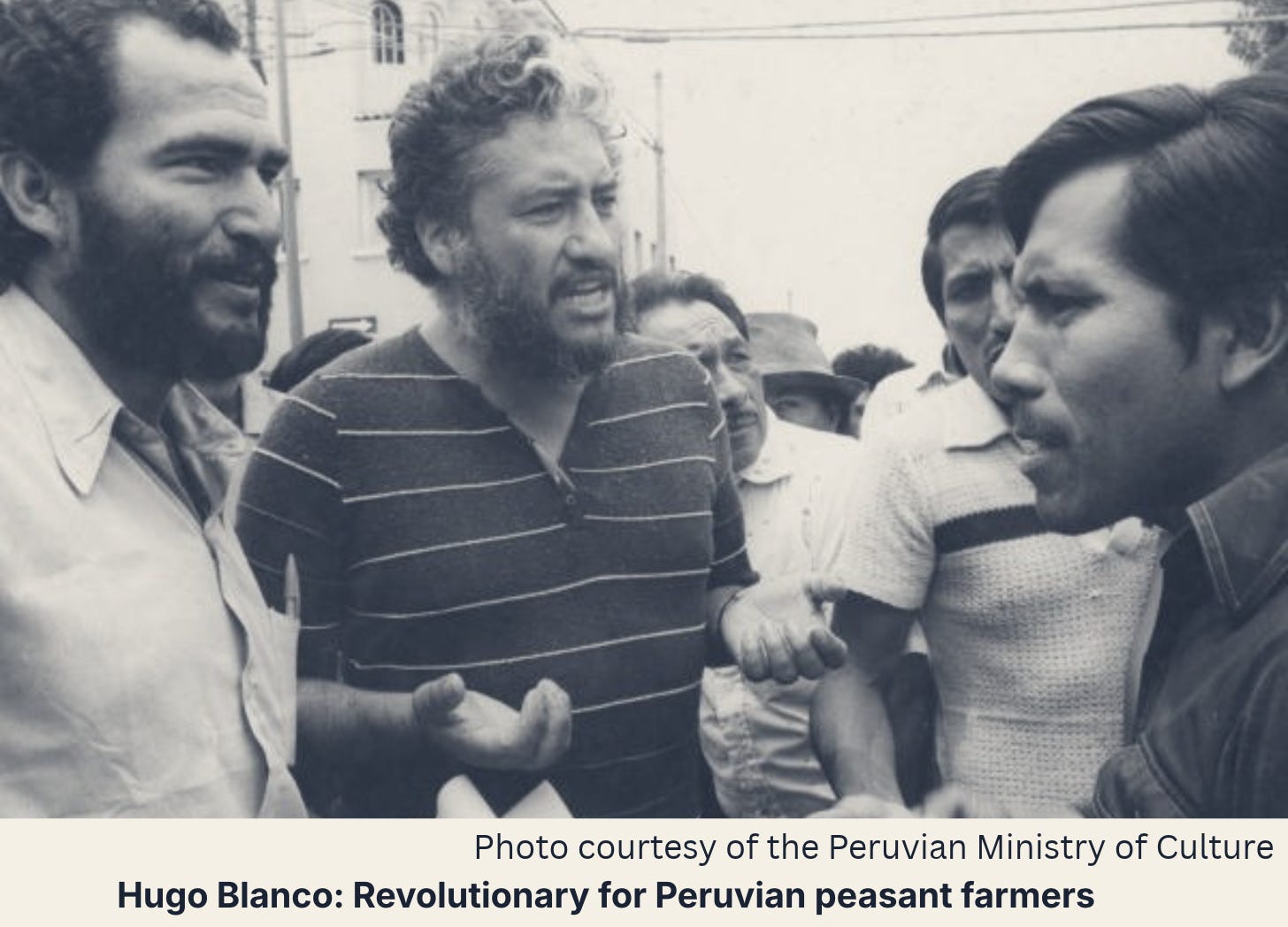
On the eastern slopes of the rugged Peruvian Andes, a rare mushroom grows. A delicacy. And the market woman had a mound of them.
Hugo Blanco offered to buy the lot at full price. “No, if I sell you all of them, what am I going to sell everyone else?” Blanco recalled the woman saying. “Selling wasn’t just business but a social relationship,” he concluded.
Blanco, who led a sometimes violent uprising of Peruvian farmers in the 1950s and ‘60s, would tell this story to demonstrate that transactional capitalism not only exploits; it runs counter to his people’s culture.
Blanco was half Quechua, an Andean people who for centuries tended terrace farms clinging to steep mountain slopes. They worked cooperatively on communal land in communities called ayllus. Spanish Conquistadores shattered that ideal in the 16th century, claiming vast “haciendas” and making the Quechua their tenants. And the exploitation had only begun.
By the time Blanco was born in 1934, the culture of ayllu struggled to survive in the feudal system the colonizers had imposed on them. Privately owned plots were allowed, but grazing land was communally owned, and cooperative work arrangements were common. But large landowners made the laws, owned the police, and expected free labor from their tenants. As a child, Blanco heard of one landlord branding a tenant with a hot iron.
His mother was from a Quechua farm family; his father a lawyer who represented Quechua interests. He went to college in Argentina to study agronomy, joining a generation of South Americans embracing Marxism as a legitimate remedy to colonialism.
He dropped out of college to join Peruvian Trotskyists when an American-backed coup unseated the elected president of Guatemala in 1954. The scheme had been provoked by United Fruit Company, whose hold on Central American and Caribbean governments gave rise to the term “banana republic.”
The town of Cuzco sits at 11,000 feet in the Andes. “In Cuzco, for centuries, the Indian had slouched along the streets with his poncho and his whispered Quechua; he had never dared, even when drunk, to mount the sidewalk or speak his Quechua out loud with his head held high. He was fearful of the misti (the non-Indian), who was the master of the city.”
Here is where Blanco started a revolution. To raise Quechua self-esteem, he started with mass meetings in the towns of the La Convención Valley, a coffee-growing country on the slopes below Cuzco. “The mass meeting put the Indian on top of the monster,” he wrote. “A concentration of ponchos in the main plaza, the heart of the city. At the court on the cathedral portico, which dominates the plaza like a rostrum. The odor of coca and Quechua permeating the air. Quechua, out loud from the throat; Quechua shouted, threatening, tearing away the centuries of oppression. A march down the main streets, before and after the meeting. Windows and doors of the powerful fearfully slammed shut at the advance of the multitudes, aggressive, insulting, threatening, shouting in Quechua truths silenced by centuries of Castilian Spanish.”
Blanco’s union called months-long strikes that tied up transportation and industry. They urged farmers to ignore eviction notices, and rather than fight in court, “change lawyers” and buy a gun. They created a shadow government, appointing judges who “legalized” the peasant farmers’ land claims.
It was a strategy Blanco called “dual power,” with a “peasant democracy” on the ground wresting daily control from the “exploiter’s government.” During one work stoppage, a merchant tried to travel, but was stopped at the city limits by strikers and told he needed permission, and not from the police. “Choking back his rage, the merchant had to come soliciting my signature as president of the strike council.”
“The pleasing thing about this development of the Peruvian copper mines is that American capital is back of the enterprise.”
--Irving Dudley, U.S. Minister to Peru, 1901
The Conquistadors got the ball rolling, but the U.S. Gilded Age barons took naked capitalism to new heights. The Andes’ rich copper veins, its impoverished workforce, and its accommodating bureaucracy were too good to pass up. But communist agitators and their unions had become a worry, especially after Fidel Castro’s successful peasant uprising in Cuba.
In response, President John Kennedy in 1961 pledged $10 billion for the Alliance for Progress to spur Latin American development and stave off communist rebellion. But the program’s focus on big road-building projects failed Peru, whose $10 million request for farming hand tools went begging.
The success in Cuba was fueling the spirits of Peru’s insurgents. “It proved that the Latin American revolution is a socialist revolution, that this revolution will not be made by peaceful means, and that it is indeed necessary to destroy — not reform — the capitalist system,” Blanco wrote.
That destruction required conflict, and the first spark came in March 1962. High in the Andes, near the U.S.-owned Cerro de Pasco copper mine, peasant farmers seized ranches they said were theirs, some held by the mining company. The Peruvian government sent 500 troops who fired tear gas and rifles at squatters “armed with knives and slingshots.” The New York Times reported 18 were killed.
Blanco’s union leaders took the opportunity to launch a region-wide strike, demanding the property be returned to the peasant farmers, that the guardsmen be punished, and the families of the victims be compensated. They knew they were risking a government crackdown, and the more conservative Communist Party leadership convinced them to scale it down after two months.
A disputed presidential election in the summer resulted in a military coup, whose general launched a roundup of communists he said were “financed by Moscow, Prague, and Havana.” A protest group claimed dozens of farmers were killed and thrown into the river; sabotage to a copper smelter caused $4 million in damage.
As the movement’s “secretary of agrarian reform,” Blanco traveled the countryside around Cuzco. He was wanted by the authorities, so he stayed at a different house every night and sometimes camped in the hills, “always with my guerrilla equipment at hand.”
Blanco’s cadres began to prepare for armed struggle. Informal target practice for women was begun in Chaupimayo. A photo of the scene made the rounds of the La Convención Valley.
Landowners began to threaten peasants with weapons. “We explained that if the landowners were armed and threatening the peasants and if the police, also armed, were clearly on the side of the landowners, the only recourse was for the peasants to arm themselves,” Blanco wrote.
Over the objection of more conservative leaders of the Communist Party, the La Convención and Lares valley insurgents decided to form and train a militia, and put Blanco in charge. Tensions increased. A union cadre executed a “traitorous” political bureaucrat, which the government used as a pretext for a crackdown.
“We had to choose between dying of malaria and going down fighting. We chose the latter … We considered it necessary to educate the masses, to show them how the peasantry must fight the armed force of the enemy even to the last.”
In hindsight, Blanco would write that he did not regret the decision to choose armed confrontation. But he did regret that investment had not been made in a sound party apparatus that would organize all aspects of the struggle, including oversight of the militia.
The landowner of the Qayara hacienda, aided by government Civil Guards, harassed a union leader’s family and threatened to shoot a boy if he didn’t reveal his father’s whereabouts. “The landlord then propped the gun barrel on the child’s arm and fired.”
A peasant was killed in an attack on a union meeting in Cuzco.
Blanco was put in charge of an expedition to Qayara, armed and permitted “to make use of them if necessary.” Though it was called a “commission,” “in reality, the guerrilla band was born at that moment,” Blanco wrote. The band named itself after Remigio Huamán, the peasant killed in the Cuzco meeting.
Before reaching their destination, they got into a firefight with police. Over the ensuing months, the band traveled the countryside like Peruvian Bonnie and Clydes, accepting accolades and supplies from the peasantry and organizing them into unions. They engaged in two other armed confrontations. At least two police officers were killed.
In early 1964, Blanco was arrested and faced execution for murder.
By then, elections had returned to Peru. To tamp down the violence, and acknowledging the peasant farmer land claims, the newly elected President Belaúnde ordered 13 haciendas totaling 50,000 acres to be given to the peasants. The government built schools, community centers, and health stations in areas participating in its “popular cooperation” program.
But as late as 1965, the insurgency continued. As a New York Times writer put it in fall 1965, “Communists have stepped up their efforts … to harness the latent resentment of the Indian peasant masses against oppression and misery into a boiling revolutionary force.” The government continued to “mop up” resistance, with suspected guerrilla positions strafed by napalm and machine gun fire.
Three years after his arrest, Blanco was put on trial for the murder of the police officers.
During his trial, townspeople cheered as he was led from cell to court. One told his lawyer: “Tell Blanco that if he has to die, then let him die, but he must not sell out!” In court, Blanco told the judges that he held no animus toward police officers. “The ranks of the army and police are part of the exploited population, used by the exploiters to maintain social injustice.”
“Give them hell, brother,” one guard told him.
As he was sentenced, “Several comrades gave cheers for the revolution and shouts of ‘Land or Death!’ that were answered by the people with ‘Venceremos!’ (we will win).”
An international furor prevented his execution. “That campaign showed that it is possible to stay the assassins’ hands and that it is our obligation to extend the struggle on a global scale to stop Yankee genocide in Indochina,” Blanco wrote.
While in prison, there was another military coup. General Juan Velasco expropriated 22 million acres of land, but rather than give it to peasant farmers, he made them state-run cooperatives.
“The bureaucracy remains the bureaucracy,” Blanco wrote from prison in 1969. “In addition to fulfilling its function of serving the oppressors (in this case the pro-development bourgeois sector), it more than ever serves its own interests. It will certainly offer no resistance to bribery.”
Indeed, the cooperatives dissolved, and the land was divided among members or, for the coastal sugar estates, later sold to companies.
Blanco was freed and sent into exile in 1970. He experienced the second U.S.-backed coup of his life while in Chile. While President Salvador Allende was overthrown, he took refuge in the Swedish embassy there. Ambassador Harald Edelstam helped spirit him out of the country, and he lived a while in Sweden.
By the late ‘70s, democracy had returned to Peru, and so had Blanco – as a successful candidate for the country’s Constituent Assembly. Nobel Prize-winning economist Friedrich von Hayek, a champion of free-market capitalism, came to Lima for a symposium.
Outside his hotel, the streets were mobbed with street vendors selling clothing, home goods, services, and food. Hayek might have been thrilled to find 250,000 entrepreneurs crowding the streets, their small businesses dodging big-government regulation and taxes. But when a New York Times journalist asked who they would vote for in the elections, “Most of them sympathized with Marxist candidates and with Hugo Blanco, an ex‐guerrilla who was once sentenced to 25 years in jail for shooting two policemen and whose beard is thicker than Fidel Castro’s.”
The Cerro de Pasco copper mine and its La Oroya smelter, which left nearly all La Oroya’s children with lead poisoning, was nationalized by General Velasco in 1974. The smelter was sold to U.S.-based Doe Run in 1997. In 2024, the Inter-American Court of Human Rights held Peru responsible for poisoning La Oroya’s residents.
Like the woman who would sell her mushrooms only to the entire community, Blanco believed saving the land was existential. It was ecosocialism.
“At first glance, defenders of the environment or conservationists seem like nice, rather eccentric fellows, whose main goal in life is preventing the extinction of blue whales or pandas,” he wrote in 1991. “The common people have more pressing concerns, for example where their next meal will come from. ...
“Who can deny the inhabitants of the town of Ilo and surrounding villages, struggling against pollution caused by the Southern Peru Copper corporation, are defending the environment? And isn’t the Amazonian population totally ecologist, ready to die to defend their forests from pillage? Or the poor population of Lima, protesting tainted water?”
In an interview with Guernica, he said: “I’ve always fought for social equality, but now there is a more important problem: the survival of my species. One hundred more years of rule by transnational companies, and they’re going to exterminate the human species as they’ve exterminated other species. …
“I think that what we need to push forward is the movement for collectivity. That’s what I believe in: power from below, and that organized society can be like that.”
Sources
Indigenous wisdom is a key theme in my novel, Mission: Butterfly. Hugo Blanco plays a role in the brighter future my butterflies create. For this essay, I read his memoir, Land or Death, which a group called Socialist Stories “liberated from capitalist control to educate the masses” and posted to the internet. It was originally published by Pathfinder in 1972.
As always, Newspapers.com was a great source of news accounts, as was The New York Times Machine.
Mission: Butterfly’s Hiêu Nguyễn meets Hugo Blanco. But he has a long way to go to get to that point in his mission. Follow him on his first day in mid-century Vietnam in these sample chapters.
Or preorder Mission: Butterfly now (goes on sale Feb. 2, 2027).