It was noon on July 1, 1958, in the middle of the Pacific, and Earle Reynolds was about to cross a line. “There was nothing there: no wire, no land, nothing painted on the water, only waves,” Reynolds later recalled. But a line was there nonetheless, and when he crossed it, everything would be different.
It had been a rewarding 47 years so far. He was born to a traveling circus family, his father killed in a fall from the tightrope when he was only 8 years old. But his stepfather found more secure employment, and he got an excellent education. After earning a doctorate in anthropology, he raised a family in the cloistered college town around Antioch College in Ohio. The world opened up for him and his family when the Atomic Bomb Casualty Commission hired him in 1951 to study the effects of nuclear fallout on the children of Japan. He took the job for the pay and travel benefits. “I had very slight sympathy for the people of Japan.”
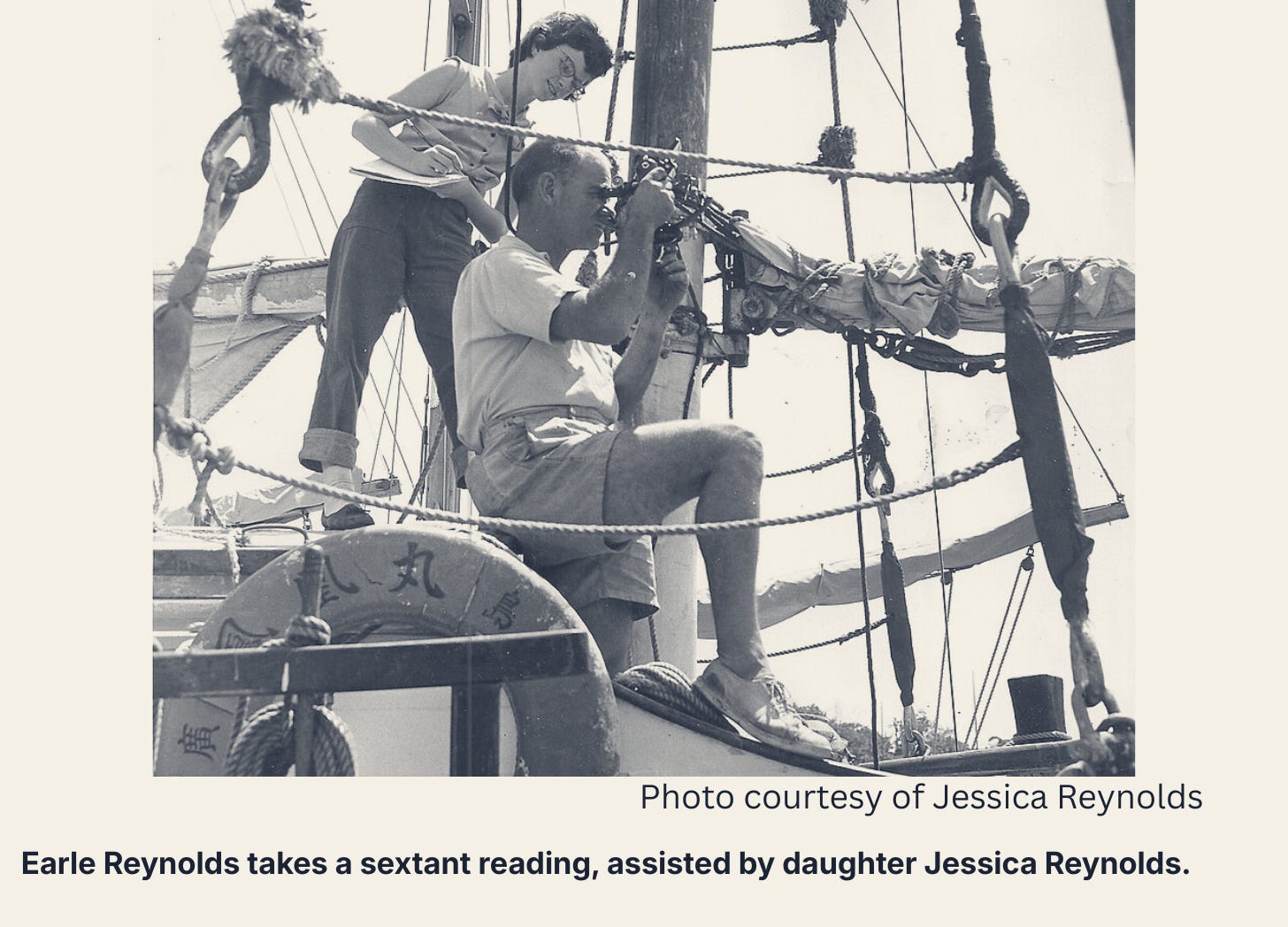
Over three years, he had done the measurements, examined the children, and filed his report: stunted growth and greater incidence of cancer, especially leukemia. Then his family and three Japanese students boarded the Phoenix of Hiroshima, a 50-foot sailing ketch he designed, and set off on a four-year cruise around the world.
At ports of call, he spoke about the impact of nuclear fallout. His Japanese shipmates shared their stories. At a time when the U.S., Soviet Union, and United Kingdom were detonating nuclear bombs over islands, Arctic ice, and deserts, people around the world were asking questions and raising fears.
But even after all that, “I wasn’t at the action level,” he later recounted to a reporter at the Oregon Journal. “I would relieve my mind by chatting about these things at a dinner party.”
Now, here he was at the tail end of the journey, an imaginary line in the ocean between him and a return to his science career.
A testy interview with Mike Wallace a year earlier had pulled him into the spotlight. Wallace, not yet a 60 Minutes bulldog, invited Reynolds on his interview show when the Phoenix put in at New York. Wallace pressed him to confirm President Eisenhower’s assertion that the U.S. had developed a “clean bomb.”
“I said to Wallace, ‘It’s nonsense. There can be no such thing.’ To which he retorted, ‘So you know more about radiation than President Eisenhower?’ ‘What are you talking about?’ I replied. ‘Of course I know more about it than President Eisenhower. He paid me a high salary to study it for him. It’s my field of competence.’”
Wallace suggested Reynolds was “giving aid and comfort to our enemies.”
“ ‘Enemies?’ I exploded. “I don’t have any, unless they are those who oppose my being a registered Democrat in Yellow Springs, Ohio. If you don’t like the sort of answers I’m giving, don’t ask the sort of questions you’re asking.”
Reynolds received several hundred letters after the interview. “Half said I was a hero, and the rest dubbed me commie pinko, fellow traveler, or traitor.”
Concerned that he had seen no mention of his Japan research in academic journals, Reynolds stopped by Washington, D.C., to investigate. “That report of yours was put in a closet,” a former secretary at the Atomic Bomb Casualty Commission told him.
“I realized that the AEC has two contradictory functions: to protect our health and to make a good A-bomb. Like many, I was inert, but now a certain finger was pointing at me and my family.”
“We arrived back in Honolulu via Panama in 1958 to find out about the furor over atomic testing at Bikini,” Reynolds recalled. Docked nearby was the Golden Rule, crewed by Quakers who had been turned back by the Coast Guard when they tried to protest the nuclear tests conducted at the Bikini Atoll. “They had told me that, to focus public attention, they were making a moral protest against nuclear weapons.”
When the crew of the Golden Rule was jailed after a second attempt to sail into the AEC’s exclusion zone, Reynolds sat down with his family and crew. The government had cordoned off 390,000 square miles of ocean between them and their home port of Hiroshima. Should they challenge that?
His wife, Barbara, said they, their boat, and his expertise in nuclear fallout all conspired to put them in this place, at this time, to make a difference. Son Ted, 18, who had researched the laws of the high seas, also was a go. Daughter Jessica, 14, refused to be left behind. “Remember, it’s my world too, and I have a right to fight for it just as much as you have.”
And their Japanese crewmates—Niichi (”Nick”) Mikami, who lost family in Hiroshima, Motosada (”Moto”) Fushima, and Mitsugi (”Mickey”) Suemitsu—were all ready to cross the line.
At the wheel of the Phoenix weeks later, the line was not visible, but the consequence was clear: “There were distant dots, half the U.S. Navy, on the horizon.”
Reynolds keyed the mic on his radiotelephone. “The United States yacht Phoenix is sailing today into the nuclear test zone as a protest against nuclear testing.” Sixty-five miles into the zone, two Coast Guardsmen boarded the Phoenix and arrested Reynolds.
In the predawn darkness of their second day under escort, a brilliant light flashed across the sky, “like a gigantic flash bulb, oval in shape and at about five to fifteen degrees above the horizon.” Ted Reynolds later confirmed he had seen America’s latest test of a nuclear bomb.
Earle Reynolds received financial and moral support from letter-writers around the world during his two-year legal battle. He was allowed to travel and speak while the case was pending, thanks to an emergency docket ruling by Supreme Court Justice William O. Douglas. He was eventually acquitted, with a judge ruling the U.S. government had no jurisdiction over the high seas.
With no standing left in the scientific community, Reynolds went all in on civil disobedience. In 1961, he and his family sailed into Soviet waters to protest nuclear tests in the Arctic. He captained an international crew that sailed the Everyman III from London to Leningrad in 1962. He and the crew were tied up by Soviet authorities and never allowed to disembark to share their anti-nuclear leaflets. Back aboard the Phoenix in 1967, he delivered medical supplies to victims of American bombing in North Vietnam.
By then, he and Barbara had divorced. She toured the world with Japanese A-bomb survivors and established the World Friendship Center, which continues today as an educational memorial in Hiroshima.
With his second wife, Akie, Reynolds attempted to pierce China’s isolation by sailing into Shanghai on unsuccessful goodwill missions in 1968 and 1969. He had crossed another line. Japan expelled him as an undesirable alien. “I was the first, but not the last, foreigner to be deported for pacifism.”
Back in the United States, he found shelter in his adopted religion, the Society of Friends.
In 1971, Reynolds and Akie asked to stay a couple of weeks at a Quaker retreat center in the redwoods near Santa Cruz, California. They became the Ben Lomond Quaker Center’s first paid caretakers. After their three-year commitment expired, Reynolds sold the Phoenix and used the proceeds to buy permanent housing on the land.
Reynolds blazed trails through the redwoods and taught peace studies at UC Santa Cruz. Calling himself a “freelance floating peacenik,” Reynolds spent the remainder of his life speaking against war and for peaceful solutions to poverty and injustice. “We need a change in society, and I don’t mean tinkering with the carburetor,” he told an audience in 1972. “The whole system needs changing. We need broad changes all over the world. If we don’t change soon, the end will come for mankind from lack of non-renewable resources.”
In a 1986 interview, he acknowledged the cost of crossing that imaginary line in the Pacific. “As soon as I stepped over the boundaries, as soon as my findings became politically sensitive, I lost my credibility as a scientist.”
But he believed he had an impact: “Now a scientist will stand on a podium and say what I was saying 30 years ago. I’m like a voice in the wilderness that finally begins to hear answering voices.”
The Atomic Bomb Casualty Commission suspended its study of Japanese children. Reynolds’ report was classified and never published. But later research attributed tens of thousands of deaths to fallout from nuclear tests, including an estimated 11,000 to 15,000 deaths in the United States.
Reynolds taught others the power of crossing lines, holding workshops as part of the Movement for a New Society, a Quaker offshoot. He was among 1,900 arrested while protesting the Diablo Canyon nuclear power plant in California in 1981.
Crossing lines puts pressure on power and results in change: Nuclear powers agreed in 1963 to stop above-ground testing. But lines get redrawn. The Trump administration is looking into restarting nuclear bomb tests.
Sources
Clippings in Newspapers.com provided the bulk of my sourcing, especially a feature published June 19, 1972, by Eric Robinson in the Oregon Journal.
Also helpful was an April 21, 2016 blog post by Jessica Reynolds Renshaw that I retrieved here.